The benefits and challenges of nuclear fusion: the pros and cons of the energy of the future
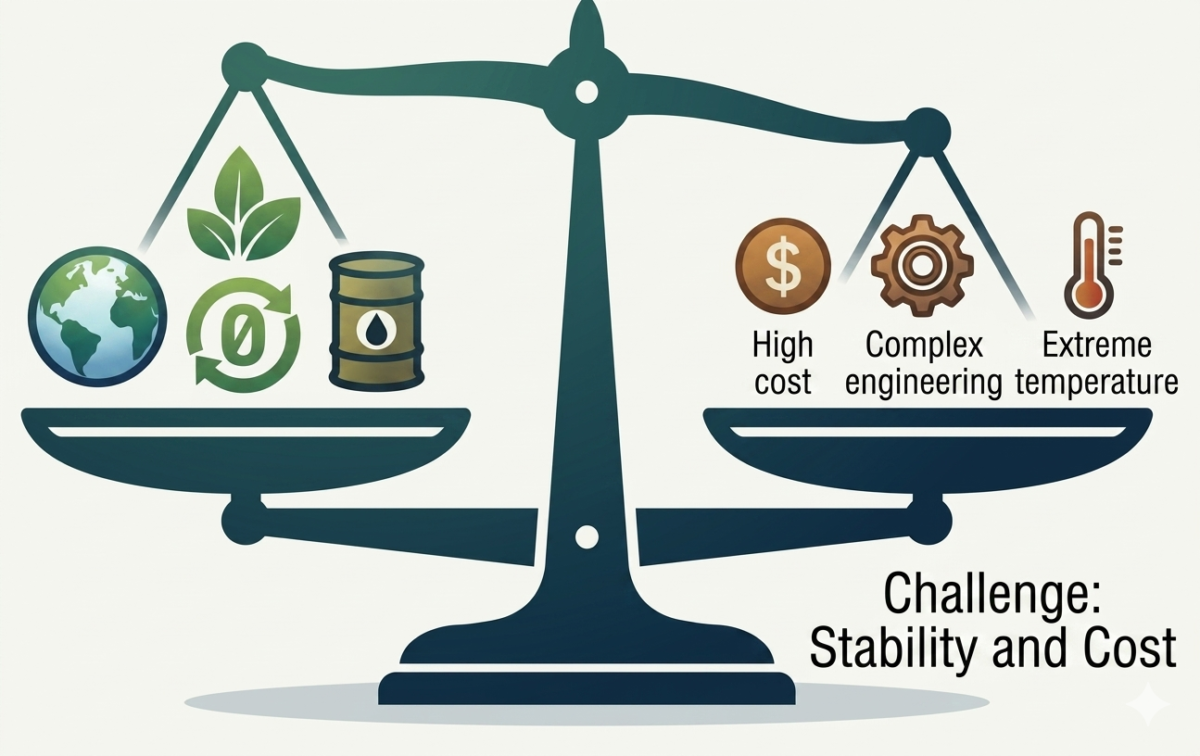
Nuclear fusion is often presented as the ultimate solution to humanity’s climate and energy crisis. However, like any historic milestone, the path to the ‘Holy Grail’ of energy is fraught with revolutionary promises, but also with extreme technical challenges. To understand the true potential of this technology, which aims to be developed on a large scale by the second half of this century, it is necessary to weigh up its advantages and challenges.
Advantages: Why will it change the world?
If we compare the benefits of fusion with those of any other current energy source, the result represents a complete turnaround for the planet:
- Absolute safety: As this is not a chain reaction (unlike current nuclear fission), it is physically impossible for the reactor to go out of control. At any time, and in the event of any technical mishap, the reaction can be brought to a complete halt simply by shutting off the fuel supply. The plasma cools instantly, and the reactor shuts down naturally.
- Cheap, abundant, and accessible fuel: The main ingredients for fusion are geographically distributed evenly and are cheap, abundant, and non-radioactive in their natural state. It is estimated that there is enough deuterium and lithium in the water of our lakes and oceans to supply the Earth for millions of years.
- 100% clean energy: The gases produced by fusion contribute nothing to the greenhouse effect. The reaction itself does not inherently generate radioactive waste; its only direct product is helium, a noble gas that is inert and completely harmless.
- Manageable materials in the short term: Indeed, the neutrons emitted during the reaction can indirectly render the plant’s structural components radioactive. However, by carefully selecting innovative, low-activation materials, this radioactivity is drastically minimised. As a result, radioactive waste will only need to be managed for around fifty years until it becomes completely safe again.
Challenges: Why is it proving so difficult to achieve?
If the fusion is so perfect, why isn’t it already lighting up our cities? The answer is that it requires solving engineering problems that border on science fiction:
- Extreme temperatures and materials: For atoms to overcome their natural repulsion and fuse, temperatures of around 100 million degrees Celsius are required inside the reactor. The major challenge lies in developing and securing advanced structural materials capable of withstanding such extreme heat and neutron bombardment without degrading.
- Colossal economic costs: The extreme complexity of these machines entails such astronomical financial investments that, at present, they are practically unaffordable for the private sector alone. For this reason, the development of fusion is taking place through historic agreements between the governments of the world’s most powerful nations.
- A long-distance race against time: the largest scientific project on the planet, the ITER experimental reactor in France, has the mission of demonstrating that it is possible to sustain a large-scale, self-sustaining fusion reaction. But ITER is merely an experiment; once it succeeds, humanity will have to build a demonstration reactor (known as DEMO) to begin feeding real electricity into the grid, which places the commercial horizon at the end of this century.
Fortunately, science is advancing rapidly, and two revolutionary technological developments could drastically reduce these lead times:
- High-temperature superconductors: If the latest advances in these new materials are successfully realised and established, it will be possible to manufacture much more powerful and efficient magnets. This will bring down costs and enable the size of reactors to be significantly reduced.
- The SPARC project: Smaller alternative projects based on these new superconductors (such as the SPARC reactor in the United States) are making such rapid progress that they could bring commercial fusion much sooner than official timetables predict.
Nuclear fusion is neither an easy nor a cheap technology in the short term, but the coordinated effort of the global scientific community is well worth it: we are just a few technological steps away from finally harnessing a source of clean, safe and inexhaustible energy for all time.
If you’d like to find out more about nuclear fusion, don’t miss the following articles:
🌐 What is nuclear fusion?: The starting point: the difference between nuclear fusion and fission.
🌌 The physics of the reaction: How do atoms fuse and why do they release so much energy?
🌊 Fuel: Sea water and lithium: Discover why the secret to fusion lies in sea water.
🔄 The tritium cycle: How do reactors plan to produce their own fuel?
🧲 Technology and confinement: Giant magnets and lasers: how we control plasma.
🌍 The current state of fusion: From ITER to private companies: this is the global scientific race.
🗓️ When will fusion be ready?: The timeline for humanity’s greatest energy promise.


