Fusion Fuel: Sea Water and Lithium. The Energy Hidden in a Glass of Water
The secret of nuclear fusion lies in fusing two isotopes of hydrogen: deuterium and tritium. But where do we get these elements from? Are they expensive? Will they run out like oil? The answer is that the ingredients for the stars’ engine can be found in seawater and in our mobile phone batteries.
Deuterium: A goldmine in seawater
Deuterium is a stable and safe isotope. Best of all, it doesn’t need to be produced: it occurs naturally alongside ordinary hydrogen in all the water on the planet (both fresh and salt water).
Roughly speaking, for every 6,500 atoms of ordinary hydrogen in water, there is one atom of deuterium. Although this may seem like a small proportion, there is so much water on Earth that the available deuterium is virtually unlimited. Separating it from water is a simple, well-established, and very cheap industrial process.
Lithium: The source of tritium
The second ingredient is tritium. Unlike deuterium, tritium is a radioactive gas that decays rapidly, which is why it is almost non-existent in nature. So how do we obtain it? This is where lithium comes into play.
Lithium is a light metal found in abundance in the Earth’s crust (and in seawater) that we are very familiar with today because it is used to make batteries for electric cars and mobile phones. In future fusion reactors, the inner walls of the reactor will be coated with lithium. When the neutrons from the reaction strike this lithium, it will magically transform into the tritium the reactor needs to keep running.
The power of fusion: The glass of water rule
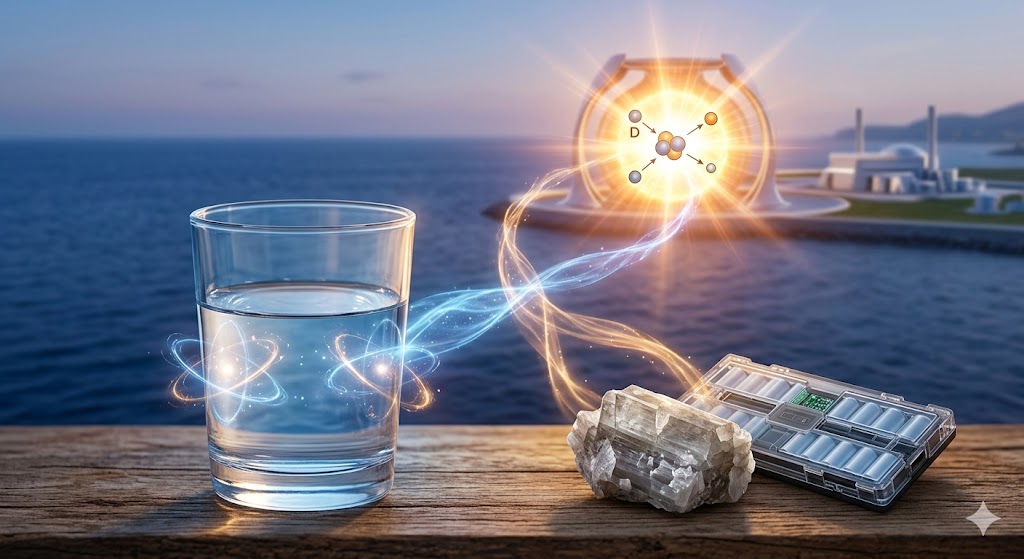
To explain why this fuel is set to change the world, scientists often use a striking comparison. If you combine the deuterium found in a glass of water with the lithium contained in a laptop battery, you get the same amount of energy as if you were to burn:
- 40 tonnes of coal.
- 40,000 litres of oil.
A 1,000-megawatt fusion power station will consume just around 250 kilograms of fuel per year (divided between deuterium and lithium); by contrast, an equivalent coal-fired power station needs to burn 2.5 million tonnes of fuel per year to produce the same amount of electricity.
Clean, continuous and “baseload” energy
Fusion does not produce greenhouse gases (its only direct ‘by-product’ is helium, an inert and non-toxic gas) nor does it generate long-lived radioactive waste. Furthermore, it can operate continuously, day and night, which is why it can be described as ‘base load power’: a massive, sustainable, large-scale supply capable of meeting the needs of our cities of the future.
If you’d like to find out more about nuclear fusion, don’t miss the following articles:
🌐 What is nuclear fusion?: The starting point: the difference between nuclear fusion and fission.
🌌 The physics of the reaction: How do atoms fuse and why do they release so much energy?
🔄 The tritium cycle: How do reactors plan to produce their own fuel?
🧲 Technology and confinement: Giant magnets and lasers: how we control plasma.
⚖️ Advantages and challenges: Is it really safe? The pros and cons of the energy of the future.
🌍 The current state of fusion: From ITER to private companies: this is the global scientific race.
🗓️ When will fusion be ready?: The timeline for humanity’s greatest energy promise.

