The Challenge of the Stars: The Current State of Nuclear Fusion
Ever since physicists understood the mechanism that makes the Sun shine in the 1930s, humanity has pursued the dream of recreating nuclear fusion on Earth. It holds the promise of a clean, safe and inexhaustible source of energy. However, moving from theory to a commercial power station represents one of the greatest engineering and planning challenges in history.
Although more than 50 countries are currently researching plasma physics and multiple fusion reactions have been achieved, the challenge remains to achieve sustained net power gain. The success of this endeavour depends on unprecedented international cooperation, a path that began to take shape globally at the 1958 UN Conference in Geneva and which is now taking concrete form in several cutting-edge projects.
ITER: The “Path” to scientific viability
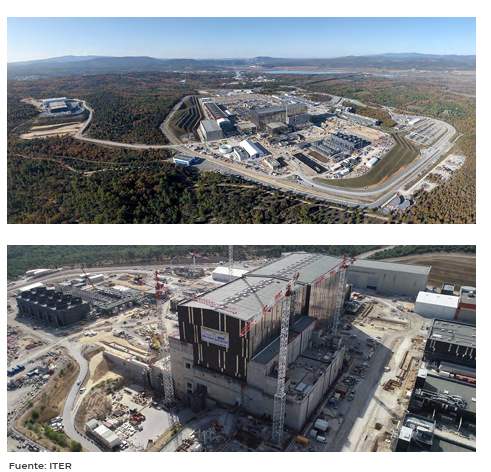
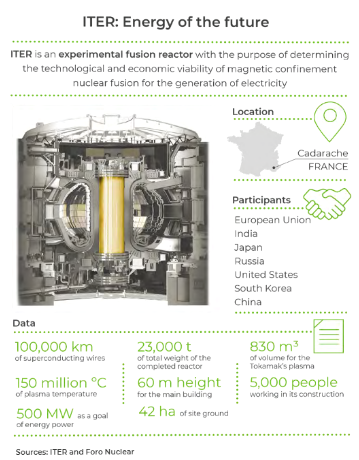
ITER (International Thermonuclear Experimental Reactor) is the most ambitious project of our time. Located in Cadarache (France), this 23,000-tonne, 30-metre-tall colossus is a collaborative effort involving 35 countries—including China, Spain, the European Union, India, Japan, South Korea, Russia and the United States.
Its objective is not commercial, but rather to demonstrate scientific and technological feasibility.
ITER will use a Tokamak-type reactor, a toroidal vacuum chamber where deuterium and tritium are ionised at extreme temperatures, confined by a powerful magnetic field generated by cryogenic coils. The milestone ITER is aiming for is to achieve an energy gain factor of Q = 10, producing 500 MW of power from an input of 50 MW. Spanish industry plays a key role in this project, exporting technology and services critical to its construction.
From science to industry: The legacy of the tokamaks
Before ITER becomes fully operational, other projects have paved the way:
- JET (Joint European Torus): Located in the United Kingdom, this reactor marked a turning point by producing 16 MW of fusion power in 1997, laying the experimental foundations for current magnetic designs.
- JT-60SA: A joint project between Europe and Japan that serves as an advanced test bed for refining the control systems that ITER will use in the future.
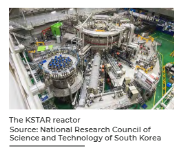
- ‘Artificial Suns’: Projects such as KSTAR (South Korea) and HL-2M (China) have achieved remarkable milestones. KSTAR has extended the duration of controlled fusion to 20 seconds at 100 million degrees, whilst HL-2M has reached temperatures of 150 million degrees Celsius – ten times the temperature of the Sun – demonstrating the ability to stabilise plasma under extreme conditions.
The disruptive factor: Private innovation (SPARC)
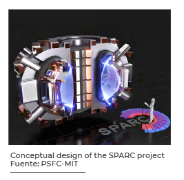
The major development in recent years has been the emergence of the private sector, with the SPARC project led by MIT and Commonwealth Fusion Systems being its prime example. Unlike the massive cryogenic structures of ITER, SPARC relies on high-temperature superconducting (HTS) magnets.
This technology allows operation at 90 K instead of the 4 K required for traditional magnets, facilitating the design of much more compact, agile, and cost-effective reactors. With an energy gain of more than two, SPARC aims to demonstrate that fusion can reach the electricity grid sooner and with lower investment costs.
Conclusion
The path to fusion energy is characterised by a necessary duality: the scale and institutional backing of projects such as ITER to consolidate fundamental physics, versus the technical agility of start-ups and compact projects seeking to accelerate commercial deployment. The mobilisation of resources on a global scale is, now more than ever, the key to transforming the energy of the stars into an everyday reality for our cities.
If you’d like to find out more about nuclear fusion, don’t miss the following articles:
🌐 What is nuclear fusion?: The starting point: the difference between nuclear fusion and fission.
🌌 The physics of the reaction: How do atoms fuse and why do they release so much energy?
🌊 Fuel: Sea water and lithium: Discover why the secret to fusion lies in sea water.
🔄 The tritium cycle: How do reactors plan to produce their own fuel?
🧲 Technology and confinement: Giant magnets and lasers: how we control plasma.
🗓️ When will fusion be ready?: The timeline for humanity’s greatest energy promise.