When will the merger take place?: The path to commercial energy
Nuclear fusion is already a reality in research laboratories, but the transition from a ‘scientific experiment’ to a ‘commercial power station’ is one of the greatest planning and engineering challenges in history. To bring the energy of the stars to light our cities, the international scientific community is following a roadmap divided into three major consecutive phases:
PHASE 1: Scientific Demonstration (The ITER Era)
The main objective is to demonstrate that we can physically produce more energy than we consume on a sustained basis over time. This is the aim of ITER (the International Thermonuclear Experimental Reactor) in France. The milestone is that ITER will not generate electricity for the grid, but will serve to prove that a giant reactor can achieve a Q-value of 10 (producing 10 times more energy than it consumes) and maintain a stable plasma.
PHASE 2: Technology Demonstration (The DEMO project)
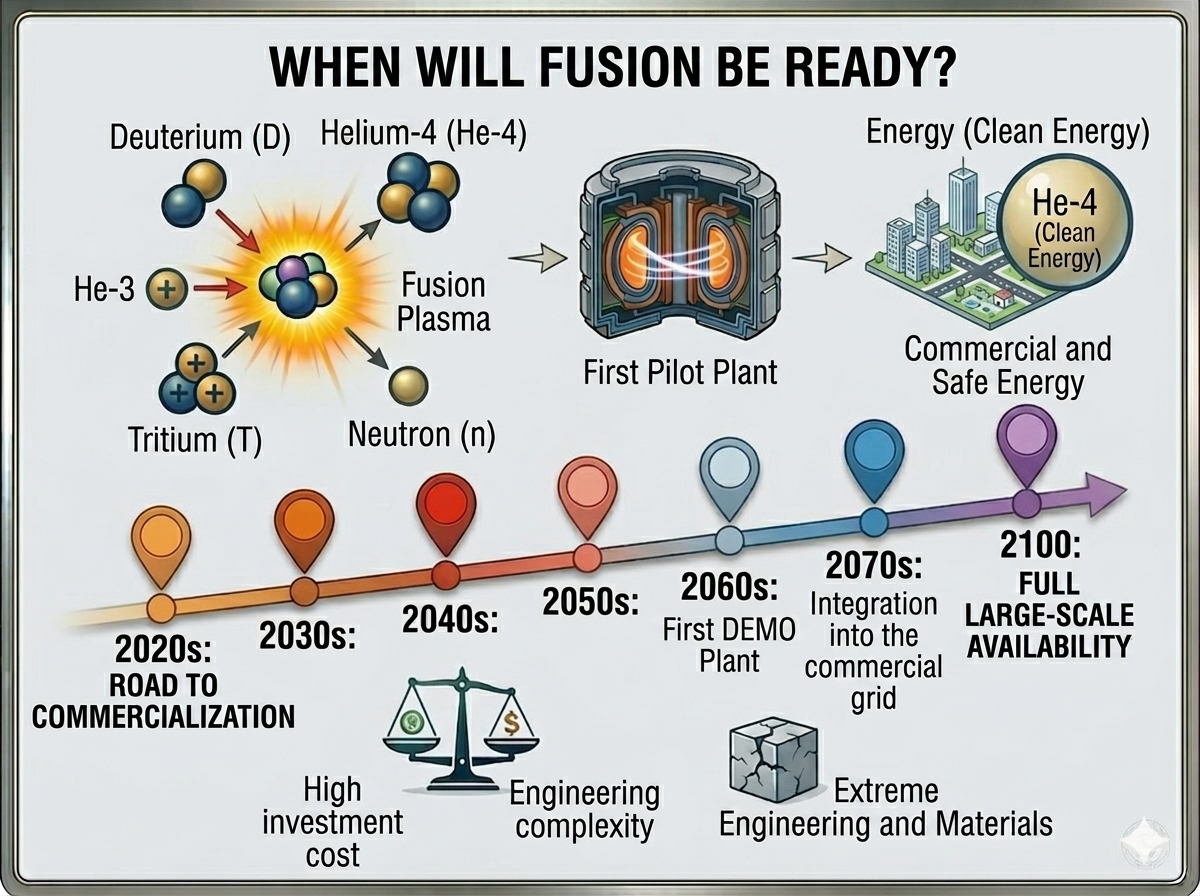
Once ITER has demonstrated the physics of the process, the next step will be to build the reactors for the DEMO (Demonstration Power Plant) phase. The key difference is that, unlike ITER, the DEMO plants will be designed to generate electricity continuously and feed it directly into the grid for the first time. The construction and operation of these pilot reactors are expected to take place around the 2040s.
PHASE 3: Commercialisation and Global Roll-out (Second half of the century)
Once the DEMO reactors have demonstrated that they are technically and economically viable, construction will begin on the first large-scale commercial fusion power stations.
Most experts and international agencies estimate that fusion energy will begin to form part of our daily energy mix by around 2050.
The impetus from the private sector
In recent years, this timeline has accelerated significantly thanks to the emergence of dozens of private companies and new technologies (such as smaller and more powerful high-temperature superconducting magnets). Although the challenge remains monumental, collaboration between international public research and the agility of private investment is bringing forward the timeline for the clean, safe and unlimited energy of the future to arrive sooner than expected.
If you’d like to find out more about nuclear fusion, don’t miss the following articles:
🌐 What is nuclear fusion?: The starting point: the difference between nuclear fusion and fission.
🌌 The physics of the reaction: How do atoms fuse and why do they release so much energy?
🌊 Fuel: Sea water and lithium: Discover why the secret to fusion lies in sea water.
🔄 The tritium cycle: How do reactors plan to produce their own fuel?
🧲 Technology and confinement: Giant magnets and lasers: how we control plasma.
🌍 The current state of fusion: From ITER to private companies: this is the global scientific race.