Technology and confinement in nuclear fusion: Giant magnets and lasers
To achieve nuclear fusion, the fuel must be heated to over 100 million degrees until it turns into plasma, which raises the great engineering question: how do you build a vessel capable of containing the heat of a star? At such a destructive temperature, any material found on Earth would melt and evaporate instantly. Furthermore, if the plasma touches the walls of the container, it cools down, and the reaction stops. A logical solution might be to accelerate the atoms in a traditional particle accelerator and make them collide with one another; however, physics shows us that more energy would be used to accelerate them than would be obtained from the reactions.
Therefore, the practical harnessing of fusion energy depends on the development of advanced technological systems that meet two fundamental requirements: heating the gas to extreme temperatures and confining the matter to keep it together long enough for it to react. To achieve this, current science is pursuing two completely different main lines of development.
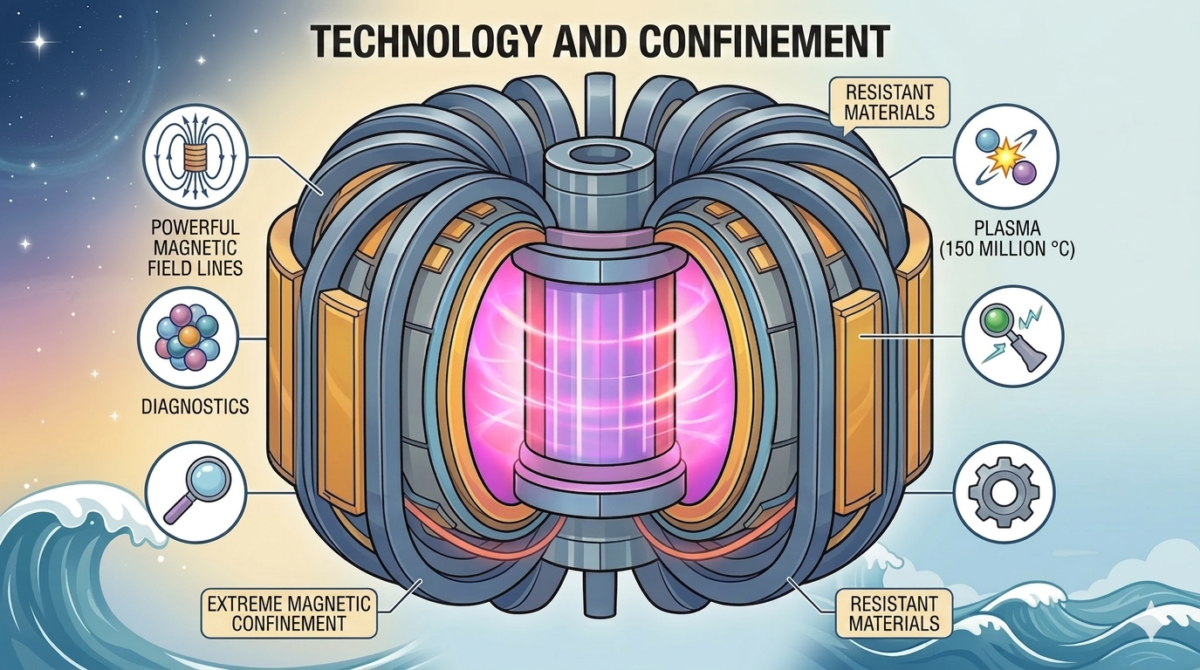
Method 1: Magnetic Confinement (The ‘invisible cage’)
It is the most advanced technology in the world and the one used in the international ITER project. As plasma is a superheated gas in which the electrons have been stripped from their orbits, the particles are electrically charged and react in a predictable manner to magnetic forces.
In this system, the plasma particles are confined within a limited space by a magnetic field, following helical trajectories determined by the field’s lines of force. The leading device in this category is toroidal (doughnut-shaped) and is called a Tokamak. Its superconducting magnets—the most powerful on the planet—create an invisible cage that suspends and shapes the plasma in the air, preventing it from touching the reactor’s metal walls.
Method 2: Inertial Confinement (The Laser Attack)
The second approach dispenses with giant magnets and seeks to create a medium so extremely dense that the particles have virtually no chance of escaping without interacting with one another.
This method involves taking a small sphere of a solid compound of deuterium and tritium (about the size of a peppercorn) and subjecting it to the sudden impact of powerful light beams generated by high-power lasers. Upon receiving this massive energy bombardment, the capsule implodes under the effects of the shockwave. In this way, the fuel becomes hundreds of times denser than in its normal solid state and explodes under the effects of the fusion reaction in a fraction of a second.
The great performance challenge: The scale of the “Q” factor
Although the number of fusion experiments has increased a hundred thousand-fold over the last few decades, the performance of the devices still needs to improve fivefold to reach the level required for a commercial power station. To achieve this, researchers are constantly trying to optimise the plasma state by adjusting three critical variables: temperature, density, and confinement time.
To measure the success of these changes, a key indicator known as the fusion energy gain is used, denoted by the symbol ‘Q’. This factor is the ratio of the fusion energy produced to the energy injected into the plasma to initiate the reaction.
- If Q = 1: A balance is achieved (we produce the same amount as we inject).
- If Q > 1: The reactor generates net energy.
To date, the European JET (Joint European Torus) reactor has achieved the best results on record, recording a Q-value of 0.67 whilst producing 16 megawatts (MW) of fusion power from 24 MW of injected thermal energy. We came close to breaking even, but much higher Q-values will be required to produce commercial electricity.
ITER’s giant leap and the magic number (Q = 5)
It has been possible to increase efficiency thanks to the larger size of the experimental reactors. In ITER, which is twice the height and radius of JET, the plasma will start in a volume 10 times larger. This colossal project is incorporating novel designs, innovative materials, and the most powerful heating devices ever built.
ITER aims to produce 500 MW of fusion energy by injecting just 50 MW of thermal energy, which will yield a Q value ≥ 10 during pulses lasting between 5 and 10 minutes.
However, there is a critical threshold in this race: Q = 5.
A Q value of 5 represents the exact point above which the plasma begins to heat itself to sustain the fusion reaction, using the energy of its own alpha particles. To better understand how to achieve this self-sustaining reaction, ITER’s objective is to generate and maintain Q values of 5 for periods far exceeding 10 minutes.
From pulses to constant power
Whilst ITER will achieve spectacular peak performance, this will only be sustained for brief periods. To supply electricity to the grid continuously, future fusion power stations will have to move beyond experimental ‘pulses’ and be capable of operating continuously. Overcoming the time barrier is the final and ultimate challenge facing nuclear engineering in its quest to finally harness the power of the stars.
If you’d like to find out more about nuclear fusion, don’t miss the following articles:
🌐 What is nuclear fusion?: The starting point: the difference between nuclear fusion and fission.
🌌 The physics of the reaction: How do atoms fuse and why do they release so much energy?
🌊 Fuel: Sea water and lithium: Discover why the secret to fusion lies in sea water.
🔄 The tritium cycle: How do reactors plan to produce their own fuel?
⚖️ Advantages and challenges: Is it really safe? The pros and cons of the energy of the future.
🌍 The current state of fusion: From ITER to private companies: this is the global scientific race.
🗓️ When will fusion be ready?: The timeline for humanity’s greatest energy promise.