The physics of the reaction: how is energy released by stars?
Nuclear fusion involves combining two light atomic nuclei to form a heavier one. But what exactly happens at the microscopic level to enable this process to release such an enormous amount of energy? The answer lies in the laws of physics and in the most famous equation in history.
The main characters: Deuterium and Tritium
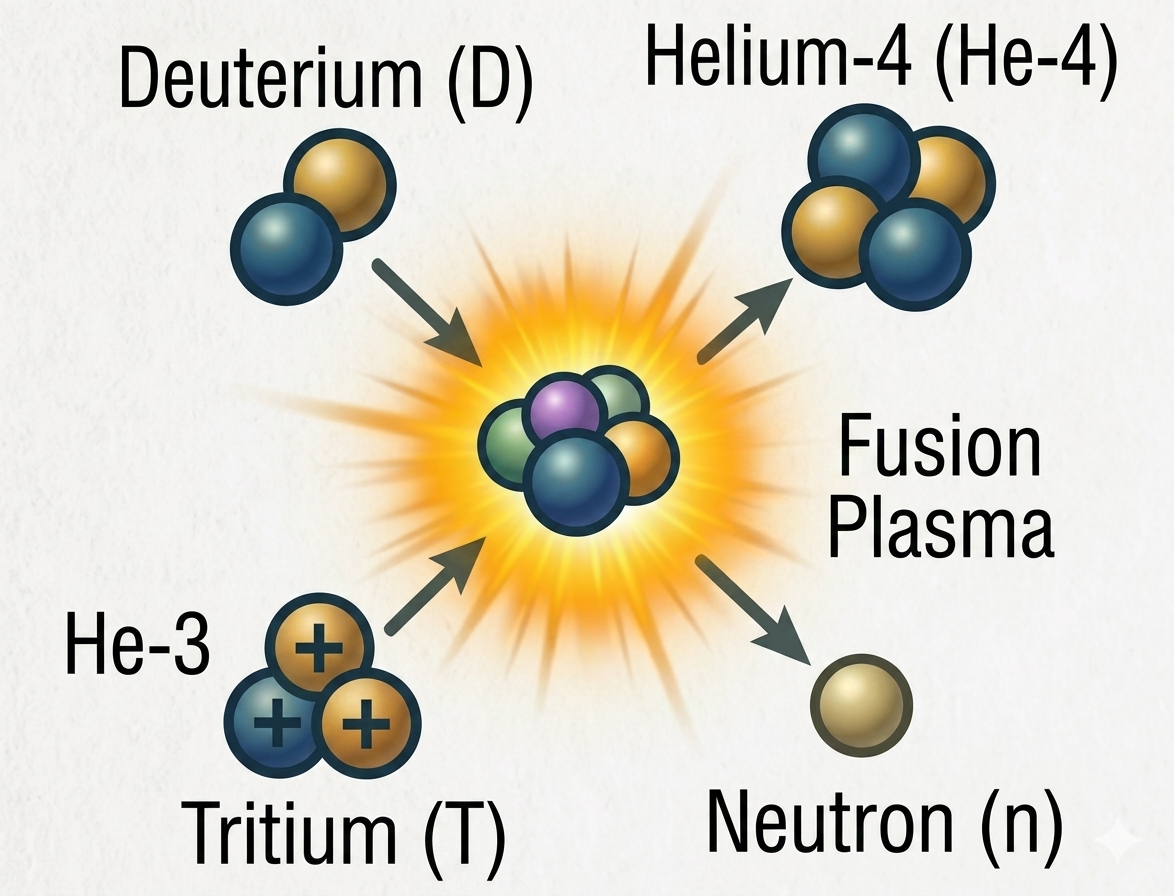
Although there are various possible fusion reactions (each requiring different temperature and density levels to be efficient), current scientific research focuses on the fusion of two isotopes of hydrogen:
- Deuterium (2H or D) has one proton and one neutron. It is very abundant and is extracted from water.
- Tritium (3H or T) has one proton and two neutrons. It is very rare in nature and is radioactive.
When these two nuclei fuse, they transform into an alpha particle (a helium nucleus, consisting of two protons and two neutrons) and release a neutron, which is ejected at high speed.
The major hurdle: Overcoming repulsion and creating 'Plasma'
Deuterium and tritium nuclei have a positive electric charge, so they naturally repel one another. To overcome this repulsive force and allow the nuclear force (which is attractive but has a very short range) to take effect, the nuclei must move at incredibly high speeds.
To achieve this, the gas must be heated to temperatures exceeding 100 million degrees Celsius. At such extreme temperatures, matter changes state and becomes plasma: a supersonic ‘soup’ where atoms break apart, and electrons are no longer bound to their nuclei, moving freely. When they collide in this state, the nuclei overcome the electrical repulsion and fuse together.
Where does energy come from? Einstein’s secret
Here comes the most surprising twist in physics. If you weigh the components before the reaction and compare them with the resulting helium and neutron, you’ll find that the final product weighs slightly less. A small amount of mass has been ‘lost’ along the way.
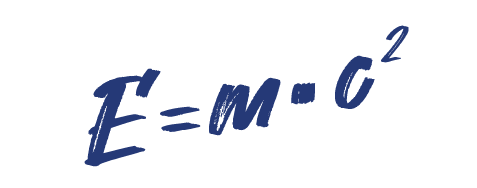
Applying Albert Einstein’s famous equation, we find that this missing mass is directly converted into an enormous amount of energy: 17.6 MeV (megaelectronvolts) for every single reaction! Although the energy required to keep the reactor running must be subtracted from this figure, the net difference is enormous, making fusion one of humanity’s most promising energy projects.
If you’d like to find out more about nuclear fusion, don’t miss the following articles:
🌐What is nuclear fusion?: The starting point: the difference between nuclear fusion and fission.
🌊 Fuel: Sea water and lithium: Discover why the secret to fusion lies in sea water.
🔄 The tritium cycle: How do reactors plan to produce their own fuel?
🧲 Technology and confinement: Giant magnets and lasers: how we control plasma.
⚖️ Advantages and challenges: Is it really safe? The pros and cons of the energy of the future.
🌍 The current state of fusion: From ITER to private companies: this is the global scientific race.
🗓️ When will fusion be ready?: The timeline for humanity’s greatest energy promise.e.