Current Atomic Model
It is the one that is based on quantum mechanics, particularly on the Schrödinger equation, the Pauli exclusion principle and a property of the electron called spin or spin. It is an evolution of several atomic models such as Rutherford, Bohr and Sommerfeld, which are considered classical or semi-classical.
It is the model with the greatest acceptance and use in the study of the structure of atoms, molecules and in the chemical reactivity of the elements, due to the precision of its predictions and its relative simplicity.
In the current vision of the atom, based on non-relativistic quantum mechanics, the concept of electronic orbits in the style of planetary systems does not fit. However, the most widespread image of the atom continues to be that of a positive central nucleus and a few dots of negative electrical charge (the electrons), revolving in perfectly defined orbits around the central nucleus. However, despite its roots, it no longer corresponds to the current atomic model.
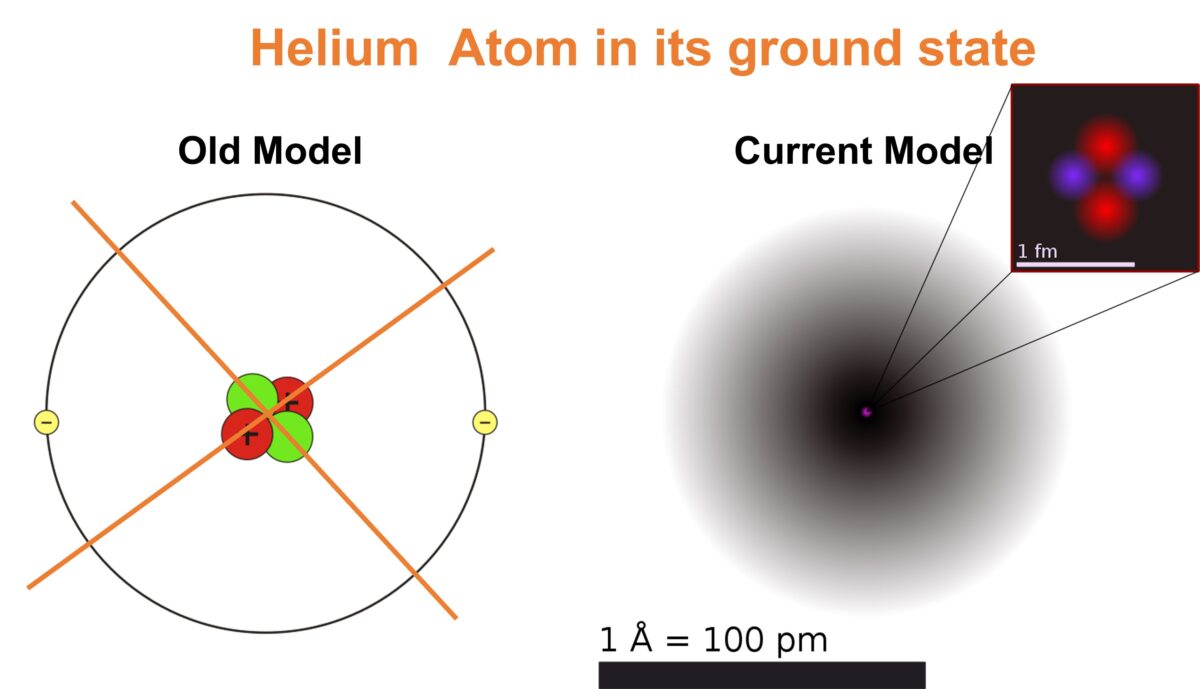
The classical image is useful to see that the nucleus contains two protons and two neutrons and guaranteeing the neutrality of the atom there are two electrons occupying the same energy level. The rest is an image far from reality, since the scale of the nucleus does not even correspond to that of the atom: the nucleus is 1/100,000 times the size of the atom, but that is where the atomic mass is concentrated.
Wave-particle duality
Classical mechanics states that every material particle has an associated wave, called the wave function. This is Louis De Broglie's famous wave-particle duality.
In the current atomic model, the behavior of the electron at the scale of atoms is prominently wavelike, while at the macroscopic level, like the electrons moving in the cathode ray tubes of old televisions, corpuscular behavior predominates.
On the other hand, with photons, the opposite happens, in most optical phenomena (at the macroscopic level) they have a fundamentally wave behavior. And when they interact with matter atoms, they have particle behavior.
Due to this, the electrons around the nucleus are scattered in zones called atomic orbitals, whose shape and extent depend on the energy level of the electrons and the angular momentum.
Both the energy and the angular momentum of the electron around the nucleus have certain allowed values, therefore they are said to be quantized.
The Schrödinger wave equation predicts which values of energy and angular momentum are allowed, as well as the wave function associated with each level of energy and momentum.
The mathematical square of the wave function determines the orbitals, that is, the areas around the nucleus where the electrons can be found with greater probability.
The size of the atom
To get a scale picture of the current atomic model, let's imagine that an atom has a diameter like that of a soccer field. The nucleus would be like an ant in the center of the field, but with a staggering 99.9% atomic mass.
On the other hand, the electrons would be like ghostly players spread all over the pitch, most likely to be found in midfield.
There are a few lineups or allowed ways to occupy the field, which depend on the energy of the players (the electrons) and the amount of "twist" or spin around the center.
Some postulates of the current atomic model
- The electron is characterized by its mass m, by its spin s and by being the particle that carries the elementary negative charge (-e).
- Electrons have dual, simultaneous wave-particle behavior, but depending on their energy and the scale of the phenomenon, one may be more preponderant than the other.
- The electrons surround the positive atomic nucleus, in such a way that they guarantee the electrical neutrality of the atom. Therefore the amount of electrons is equal to that of protons; This is the atomic number, which gives the chemical and physical characteristics of each element.
- The interaction between electrons and nucleus is modeled by Coulomb's electrostatic potential V(r), to which the potential energy term is incorporated in the Hamiltonian operator.
- In atoms with several electrons, the interaction between them is not taken into account.
- In the case of many-electron atoms, the orbitals of the outermost electrons are modeled by the potential of the nucleus shielded by the innermost electrons, which is known as the Debye potential.
- The equation of the current model has a solution for some discrete values of energy, so that the famous Planck quanta appear naturally from the solutions of the Schrödinger equation.
- The wave function determines the regions allowed for the electron. The square of the wave function is the probability density of finding the electron at a given position, viewed from the center of the atomic nucleus.
- Spin does not appear in Schrödinger's equation, but is incorporated into the atomic model through the Pauli principle: The electron is a fermion with two possible spin states +½ and -½.
- So the same state characterized by the quantum numbers n, l, m of the Schrödinger equation, can be occupied by at most 2 electrons with opposite spins. In this way, spin becomes the fourth quantum number.
Influential scientists on the current atomic model
It seems incredible, but most of the physicists who contributed to the current atomic model appear in the same photo. They met at the famous conferences sponsored by Ernest Solvay, a Belgian-born chemist and industrialist, who became famous in the world of science.
They began to be held in 1911 and brought together the greatest scientists of the moment, among them were practically all those who gave their contribution to the current atomic model.
The most famous of these conferences was held in Brussels in 1927 and this historic photograph was taken there:

According to this scheme, the participants in said conference were:
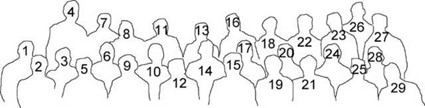
- Peter Debye
- Irving Langmuir
- Martin Knudsen
- Auguste Piccard
- Max Planck
- William Lawrence Bragg
- Émile Henriot
- Paul Ehrenfest
- Marie Curie
- Hendrik Anthony Kramers
- Édouard Herzen
- Hendrik Antoon Lorentz
- Théophile de Donder
- Paul Adrien Maurice Dirac
- Albert Einstein
- Erwin Schrödinger
- Arthur Holly Compton
- Jules-Émile Verschaffelt
- Paul Langevin
- Louis-Victor de Broglie
- Charles-Eugène Guye
- Wolfgang Pauli
- Werner Heisenberg
- Max Born
- Charles Thomson Rees Wilson
- Ralph Howard Fowler
- Léon Brillouin
- Niels Bohr
- Owen Williams Richardson


