The Toll of the Wires: Taxes and Regulated Costs
When you add together the "Power Term" and the "Energy Term", you get the direct cost of your electricity supply. However, if you look at the final part of any electricity bill in Spain, you will see that a significant portion of the final total goes toward regulated costs and taxes set by the government and regulatory bodies.
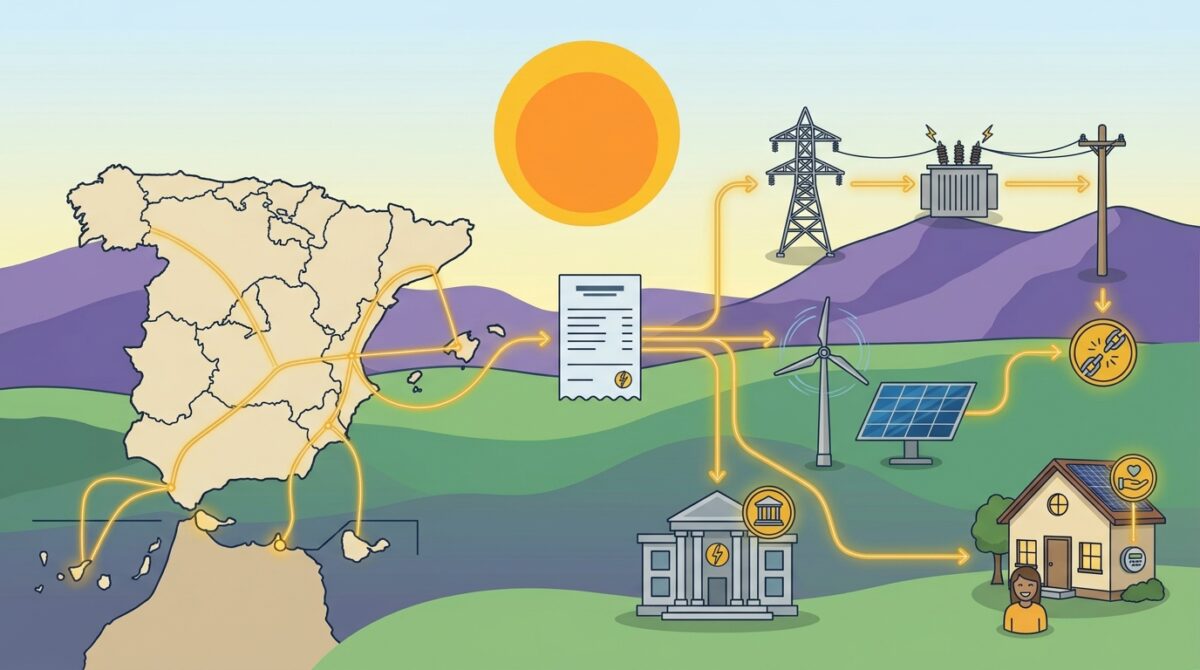
Where does that money go exactly, and why is it part of the bill? Spain's electricity system is critical infrastructure that requires continuous investment along with mechanisms for social and territorial cohesion. This final block is broken down into four elements:
- Transmission and distribution tolls: These are set by the CNMC (National Markets and Competition Commission). They pay Red Eléctrica and distribution companies to build, monitor, digitalize, and keep in good condition the hundreds of thousands of kilometers of lines and substations that bring power to our homes.
- Electricity system charges: These are set by the government to fund national energy policy goals. Key examples include:
- Support and premiums for renewable energy installed in earlier stages to drive the ecological transition.
- Territorial solidarity (non-peninsular costs): generating electricity in isolated systems such as the Canary Islands, the Balearic Islands, Ceuta, and Melilla is more expensive than on the mainland. Thanks to system charges, that extra cost is offset to bring supply conditions closer across territories.
- Paying annual installments on historical debts accumulated by the electricity system in the past.
- Meter rental: The vast majority of households do not buy their smart meter, but instead rent it from their distribution company. This fee (set by regulation at roughly under one euro per month) covers maintenance and replacing the unit if it breaks down.
- Taxes applied to electricity: On top of the items above, the corresponding taxes are applied—such as the Special Tax on Electricity (IEE) and VAT (Value Added Tax)—according to the rates in force during each period.
- Special Tax on Electricity (IEE): It is a specific tax on energy consumption (whose general rate is 5.11%, although the government has applied temporary reductions during periods of energy crisis).
- VAT (Value Added Tax): It is applied at the end over the entire taxable base (including the electricity tax), with its general rate at 21% (also subject to exceptional reductions during periods of high prices).
Finally, the system includes a key social protection tool: the Electricity Social Bonus (Bono Social Eléctrico). It is a direct discount on the bill aimed at vulnerable groups—such as pensioners on minimum pensions, large families, and households facing economic vulnerability—helping guarantee access to electricity for all citizens.