Generation Centers: The Spanish Energy Mix
Every time you flip the switch in your bedroom or plug in your phone charger, a massive supply chain activates instantaneously. Unlike water or gas, which can be stored in large tanks until someone needs them, electricity must be generated at the same millisecond it is consumed. If millions of televisions turn on all at once across the country because a football match starts, power plants must increase their production in that exact same proportion.
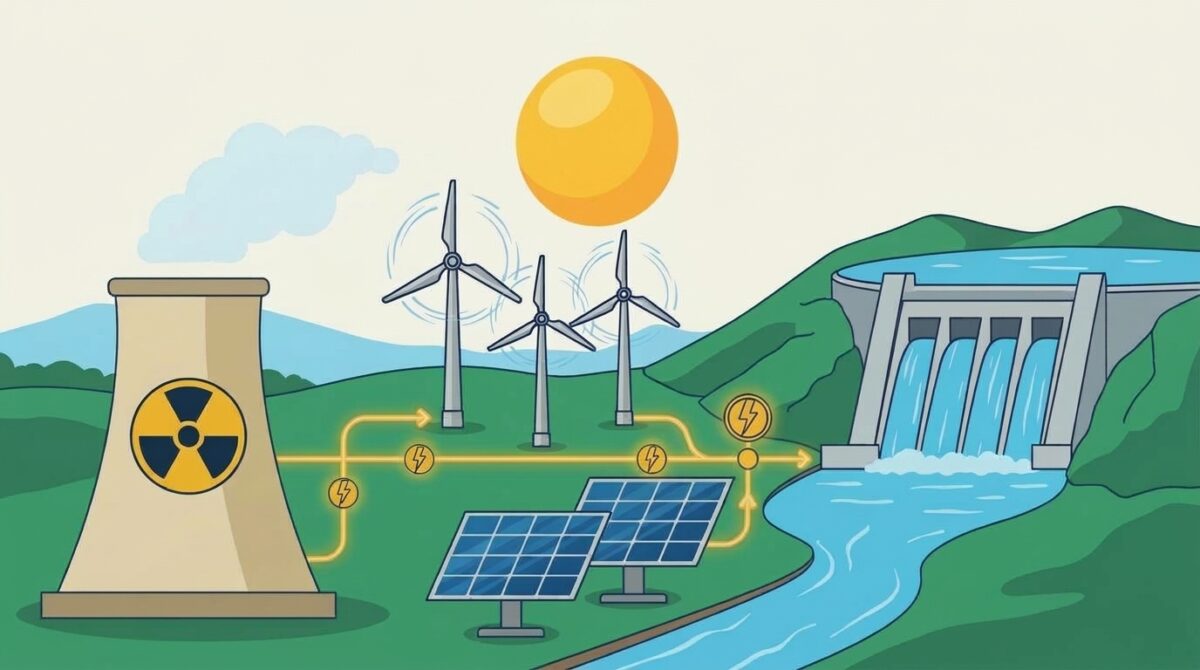
In Spain, this electricity is obtained through what we call the "Energy Mix," which is the combination of different sources and technologies that supply energy to the national grid. To keep the system safe, technologies are divided according to their role in the grid:
- Baseload and dispatchable energy (the backbone): These are technologies that do not depend on the weather and can run continuously or be activated when the grid operator orders it. Nuclear power plays a key role here, operating uninterruptedly (more than 8,000 hours a year) and providing around 20% of Spain's electricity with zero greenhouse gas emissions. Alongside it are hydroelectric plants (which store water in reservoirs and release it when needed) and natural gas combined-cycle plants, which can start up in a few minutes to cover sudden spikes in demand.
- Variable renewable energy: Wind power (which is usually the top annual generation source in Spain) and solar photovoltaic are clean, domestic, and essential for decarbonization. However, they are intermittent: they depend on the wind blowing or the sun shining.
- Storage (the giant batteries): To make the most of renewable surpluses when there is excess sun or wind, Spain mainly uses pumped-storage hydroelectric plants. When there is plenty of cheap electricity, they pump water from a lower reservoir to an upper one; when energy is needed, they release that water to generate electricity again.
How does a moving electron actually come to life? Except in solar photovoltaic panels (where photons of light directly free electrons in silicon cells), all other power plants—nuclear, wind, hydro, or gas—work under the same physical principle discovered by Michael Faraday in 1831: electromagnetic induction. An energy source (pressurized steam, water, or wind) spins the blades of a huge turbine. That turbine is connected to the shaft of an alternator, a device with powerful magnets spinning inside thousands of turns of copper wire. That magnetic movement pushes the electrons in the copper, creating the electric current that begins its journey across Spain.