Transport of radioactive waste
Radioactive waste refers to substances that, after being used or exploited in mining activities or applications such as medical uses, electricity generation, industrial applications or laboratories, still produce ionising radiation. In many cases, the word ‘waste’ is incorrect, as these substances still contain a very high percentage of energy that could be used if recycled.
The origin of these nuclear and radioactive materials can be very diverse: smoke detectors; radioisotopes used for medical diagnosis or in certain industrial or research applications; high-activity radioactive sources used primarily in cancer therapy; irradiated fuel extracted from nuclear power plants, etc. In any case, transport is necessary from the suppliers to the user facilities and, subsequently, from the radioactive waste generated by these facilities to the treatment centres.
Excluding X-ray facilities, there are some 1,300 authorised radioactive facilities in Spain, which generate approximately 30 m3 of radioactive waste and some 300 radioactive sources each year.
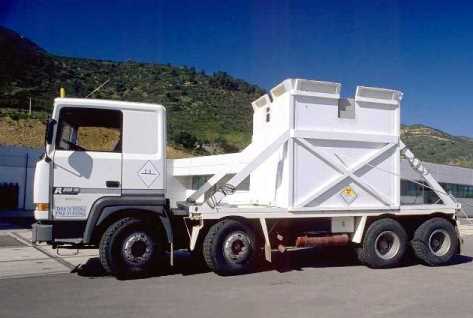
The shipment of nuclear and radioactive materials accounts for around 2% of international shipments of dangerous goods worldwide.
The transport of radioactive waste on national and international routes, which is essential for the management of nuclear materials, is governed by strict safety protocols. Global experience demonstrates the effectiveness of these protocols, with nearly 40 million kilometres travelled without incident.
In this regard, what is considered transport is divided into three stages:
- Risk analysis.
- Transport preparation and scheduling.
- Transport itself.
Radioactive substances can be transported by road, rail, sea, air and navigable waterways. The means of transport is generally chosen according to the type of nuclear or radioactive material. Here are some examples:
- In the case of medical applications. The material is mainly transported by air, as it undergoes rapid radioactive decay and therefore needs to be shipped urgently. It is then transported by road in small packages to its final destination at hospitals or diagnostic centres.
- In the case of large quantities of material, normally associated with the nuclear fuel cycle (minerals, concentrates, uranium hexafluoride, nuclear fuel, etc.), transport is carried out by sea.
- This is not the case in Spain, because at the moment it is stored in specific facilities at the power plants themselves, but if high-level waste has to be transported, it is done by rail or road in compliance with the International Atomic Energy Agency (IAEA) Transport Regulations and European Commission directives.
- Low- and medium-level waste can also be transported by air, sea or river.
Transport and logistics are also vital to ensure the transition between the different stages of the nuclear fuel cycle: mining, conversion, enrichment, fuel fabrication, fuel management and recycling, and temporary and final waste management.
Transport safety is guaranteed by a strict regulatory and control regime, which is continuously reviewed and updated and has been developed for the beneficial use of nuclear and radioactive materials with an appropriate level of protection and safety for people, the environment and the environment.
The basic concept is that safety depends primarily on packaging, which must provide a barrier to protect workers, the public and the environment from the effects of radiation.
Safety during transport is guaranteed by, among other things, armoured containers, security systems and specialised drivers. For transport originating at nuclear power plants, articulated vehicles with a maximum weight of 40 tonnes are used, equipped with specific safety features and geolocated throughout their journey.
When the origin is radioactive facilities, smaller vehicles are used to allow access to the loading sites.
Transport safety is based on the concept of a ‘package’, which combines the radioactive material and its packaging. Rigorous tests are carried out:
- Free fall from a height of 9 metres
- Free fall from a height of one metre onto a steel spike
- Fire resistance at 800 °C for 30 minutes
- Immersion tests at different depths
In addition, these containers pass tests simulating extreme situations, such as the impact of a locomotive travelling at speeds exceeding 130 km/h.
Adicionalmente, estos contenedores superan ensayos simulando situaciones extremas, como el impacto de una locomotora a velocidades superiores a 130 km/h.

Rigorous transport tests are carried out, including trials simulating extreme situations.
The vehicles used are specially designed with automatic locking systems and additional armour plating. A control centre supervises each shipment, monitors the established routes and identifies unforeseen situations.
This video from the International Atomic Energy Agency describes some of the tests conducted on radioactive waste packages.
From the very beginning of the use of radioactive materials, the IAEA undertook the task of developing safety standards for the transport of such materials. The first edition of the IAEA Regulations for the Safe Transport of Radioactive Material was published in 1961. Since then, there have been several updates to these regulations, which serve as the basis for national and international regulations.
Although they are called regulations, they are actually recommended regulatory standards for international transport activities. Each State or international/national organisation decides on their application. The IAEA therefore facilitates the correct application of these regulations through training programmes and advisory services for Member States.
In the event of an incident or emergency, action plans are defined to cover all contingencies: from the initial alert to the analysis of the situation, and carrying out actions on the ground.
All the protocols and regulations for the transport of radioactive waste that apply in Spain are quite similar to those in the rest of the world and are based on the recommendations of the International Atomic Energy Agency (IAEA).
In Spain and Europe, the transport of radioactive waste follows the European Agreement concerning the International Carriage of Dangerous Goods by Road (ADR).
The Spanish National Radioactive Waste Company (Enresa), with more than 40 years of experience, is responsible for collecting, inspecting and transporting very low, low and medium level waste.
This is not the case in Spain, because at the moment it is stored in specific facilities at the power plants themselves, but if high-level waste has to be transported, it is done so by rail or road in compliance with the International Atomic Energy Agency (IAEA) Transport Regulations and European Commission directives. Low- and medium-level waste can also be transported by air, sea and river.
Very low-, low- and medium-level waste and high-level waste are transported according to the same rules and criteria.
Don't miss this video about the tests carried out on the containers used for the road transport of radioactive waste.


