What is natural radiation?
Temas: Applications | Ionizing Radiation
Radiation is the emission, propagation and transfer of energy through any medium, whether in the form of electromagnetic waves or particles. An electromagnetic wave is a means of transporting energy (for example, the heat carried by sunlight). The higher the frequency, the greater the energy, and vice versa.
People are constantly exposed to ionising radiation. Some of this radiation comes from nature itself, without any human intervention, whilst other sources are man-made.
Radiation of natural origin constitutes the natural background radiation, which may come from:
- Outer space (cosmic radiation): [protons (86%) and alpha particles (12%)] reach the Earth every second. As the atmosphere partially absorbs this radiation, the natural background radiation — due to this cause — varies with altitude, such that it is lower at sea level than at the top of a mountain. On a global average, cosmic radiation accounts for 10% of the dose.
- Earth’s crust accounts for 14% of the global average dose.
- Human body: mainly carbon and potassium isotopes, which account for approximately 52% of the global average dose.
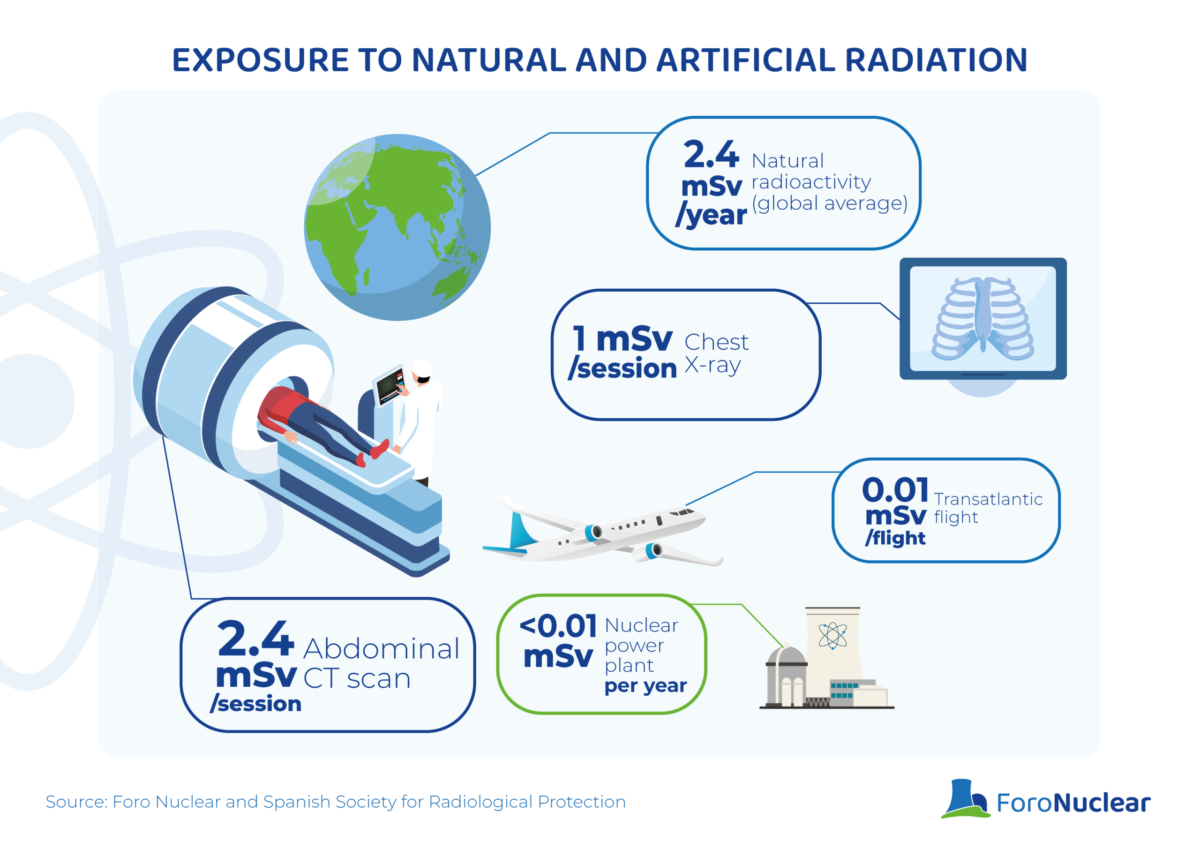
On average, the dose from natural background radiation received by a person in Spain is around 2.4 mSv per year.
Tipos: Theory
Edades: +16 years old | 06-12 years old | 12-16 years old | All ages
Etiquetas: Radiación