Radiation protection for the public and the demarcation of radioactive areas in Spain
The International Commission on Radiological Protection, better known by its acronym ICRP, is responsible for establishing the principles of radiological protection, based on current scientific knowledge of the biological effects of ionising radiation. Its conclusions are published in the form of recommendations, which provide a sound basis for the drafting of relevant legislation in each country.
Protection of workers
One of the basic principles of radiation protection is dose limitation. For workers, the effective dose limit is 20 mSv per year, which may be averaged over five consecutive years; in other words, over those five years, a total of 100 mSv may be received, provided that 50 mSv is not exceeded in any given year. There are equivalent dose limits for specific tissues or organs: the lens of the eye (150 mSv per year), the skin (500 mSv per year; a limit that applies to the average dose over any 1 cm² area, regardless of the region exposed), and the hands, forearms, feet, and ankles (500 mSv per year).
To ensure the radiological protection of workers, control and monitoring measures must be put in place to prevent their exposure to ionising radiation and to ensure that the dose limits mentioned above are not exceeded. These measures include:
- Assess working conditions.
- Classify and signpost workplaces according to the level of radiation that may be present.
- Classify workers into different categories according to their working conditions.
- Monitor the radiation exposure of workers in the workplace using dosimeters.
- Establish information and training programmes on radiation protection.
- Apply the regulations and the relevant monitoring and control measures for the different zones.
- Carry out regular medical check-ups by authorised occupational health services.
Zoning in radioactive facilities
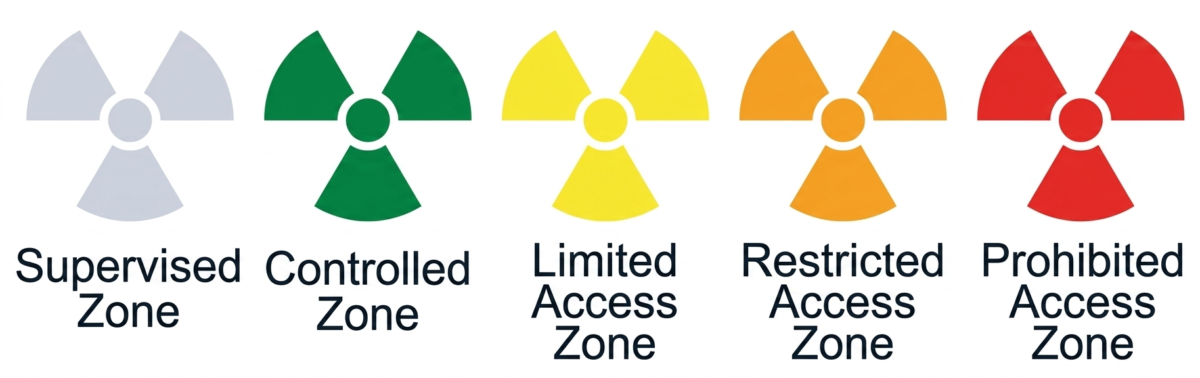
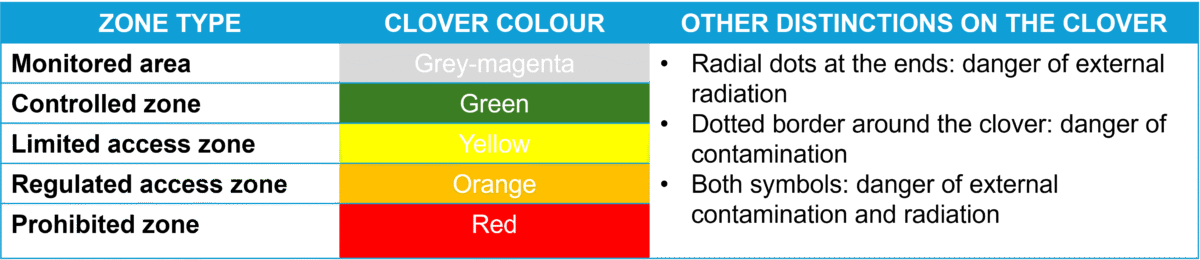
Depending on how workers may be exposed to radiation (external irradiation, contamination or both), work areas are classified as follows:
- Supervised area: An area in which there is a possibility of receiving effective doses exceeding 1 mSv per calendar year or an equivalent dose exceeding 1/10 of the equivalent dose limits for the lens of the eye (150 mSv), the skin, and the extremities (500 mSv).
- Controlled area: An area in which: (1) There is a possibility of receiving effective doses exceeding 6 mSv per calendar year or an equivalent dose exceeding 3/10 of the equivalent dose limits for the lens of the eye (150 mSv), the skin and the extremities (500 mSv), or (2) Work procedures must be followed to restrict exposure to ionising radiation, prevent the spread of radioactive contamination, or prevent or limit the likelihood and severity of radiological accidents or their consequences.
The controlled areas may be subdivided into:
- Areas with restricted access: These are areas where there is a risk of receiving a dose exceeding the dose limits (100 mSv over any period of five consecutive calendar years, subject to a maximum effective dose of 50 mSv in any calendar year)
- Regulated areas: These are areas where there is a risk of receiving a dose exceeding the dose limits over short periods of time and which require special provisions from the point of view of dose optimisation.
- Prohibited areas: These are areas where there is a risk of receiving doses exceeding the dose limits from a single exposure.
The classification of workplaces within the designated areas must always be kept up to date in line with the actual conditions prevailing; it will therefore be reviewed should there be any changes in working conditions.
Public safety
As with workers, there are dose limits for the public which, by law, must not be exceeded. The effective dose limit for the public is 1 mSv per year, with equivalent dose limits of 15 mSv per year for the lens of the eye and 50 mSv per year for the skin (this limit applies to the average dose over any 1 cm² area of skin, regardless of the exposed area).
It is important to note that the dose limits for both workers and the public do not include doses received from natural background radiation, nor those that may be received as a result of medical treatments.