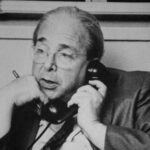
February 11, 1898 – Birth of Leó Szilárd, the man with great ideas on nuclear physics, engineering and molecular biology

He studied engineering, physics, and molecular biology in Hungary, Germany, and the United States and met great scientists such as Albert Einstein, Max Planck, Walther Nernst, James Franck, and Max von Laue.
He carried out numerous investigations, many of which were not highly valued but served as the basis for others to win the Nobel Prize, such asErnest Lawrence for the cyclotron in 1939 and Ernst Ruska for the electron microscope in 1986.
On September 12, 1933, he conceived the idea of a nuclear chain reaction, using newly discovered neutrons.
In early 1934, Szilard began working at St Bartholomew's Hospital in London, along with a physicist on the hospital staff, Thomas A. Chalmers, where he studied radioactive isotopes for medical purposes.
He participated in the Manhattan Project, contributed great ideas, researched alongside Enrico Fermi and many other scientists, and was present on December 2, 1942, when the first artificial self-sustaining nuclear chain reaction was achieved in the first nuclear reactor under the Stagg Field, the Chicago Pile-1.
In 1943, he became a US citizen, but the war continued, and his resentment towards the US government grew due to its failed attempt to prevent the use of the atomic bomb in the war. This led him to re-investigate biology and social sciences that he had left in 1933. In 1946, he obtained a research chair at the University of Chicago and became associated with Aaron Novick, a chemist who had worked at the Metallurgical Laboratory during the war. Both patented various gadgets and made great discoveries.
If you want more information about this scientist, click on the following link: Leó Szilárd