Hedy Lamarr, the Brilliant Scientific Mind Behind Hollywood’s Glamour
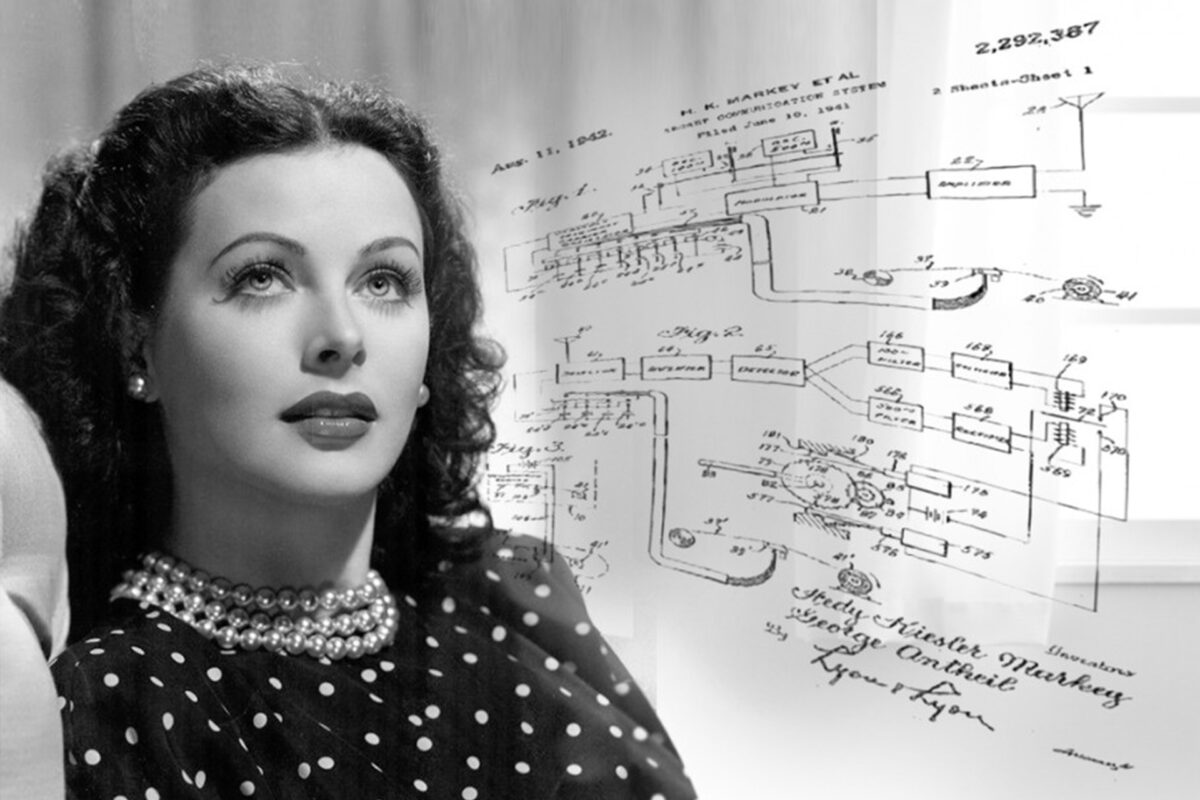
November 9, 1914, Vienna (Austria) – January 19, 2000, Casselberry (Florida, United States)
Born Hedwig Eva Maria Kiesler, Hedy Lamarr entered global history not only as one of the most iconic actresses of classic Hollywood cinema during the 1930s and 1940s, but also as a visionary inventor working quietly behind the scenes.
Although the public admired her for films like Algiers or Samson and Delilah, Lamarr dedicated her free time to thinking, designing, and solving technological problems. In an era constrained by gender prejudices, she proved that artistic talent and a deep passion for science could go hand in hand.
At the outbreak of World War II, Lamarr wanted to contribute to the Allied defense effort. Alongside composer and pianist George Antheil, she conceptualized and patented in 1942 a groundbreaking secret communication system using frequency-hopping spread spectrum technology.
Her original goal? To prevent enemy forces from jamming or intercepting the radio signals guiding military torpedoes. Although the U.S. Navy did not immediately adopt the system at the time, that mathematical masterpiece became decades later the essential technological foundation for modern wireless communications, paving the way for everyday tools like Wi-Fi, GPS, and Bluetooth.
For many years, her role as an inventor was overshadowed by her film career. Today, however, she is celebrated as an undisputed pioneer in telecommunications engineering, inspiring new generations to break stereotypes and proving that scientific curiosity is vital to transforming our world.

