August 13, 1894 - Lord Rayleigh and William Ramsay announce the discovery of argon
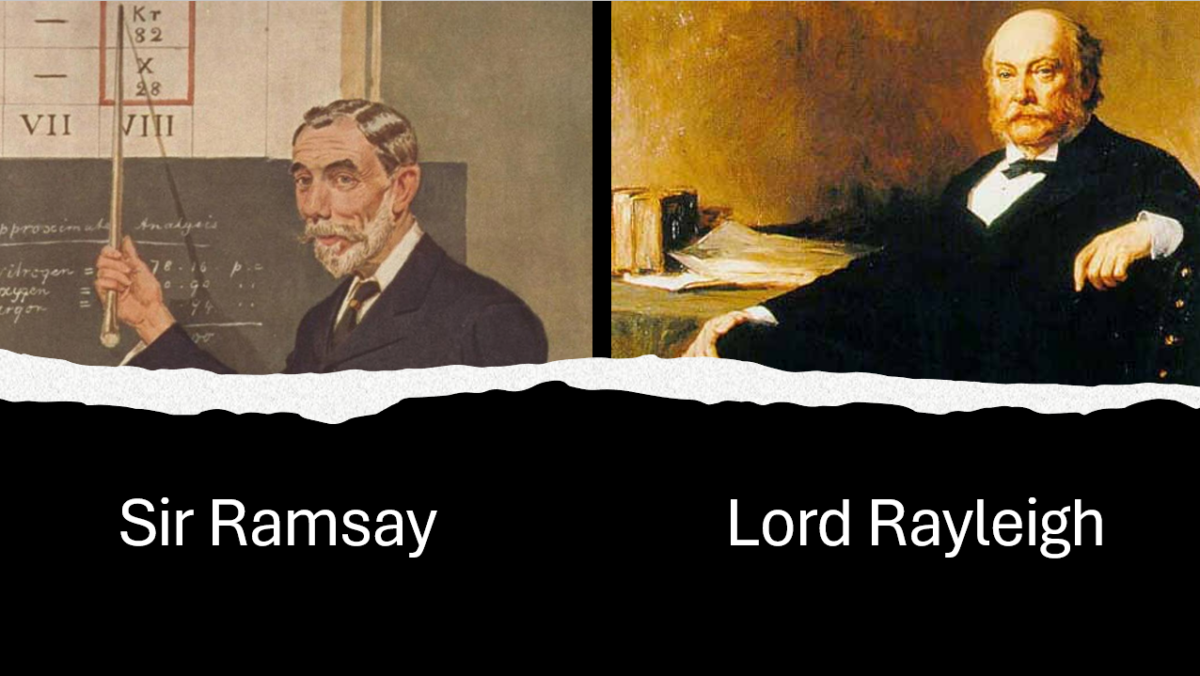
On August 13, 1894, during a meeting of the British Association for the Advancement of Science in Oxford, physicist John William Strutt (Lord Rayleigh) and chemist Sir William Ramsay formally announced the discovery of a new chemical element: argon (Ar). This finding did not just add another member to science; it opened the door to an entire family of elements completely unknown until then: the noble gases.
The Mystery of "Heavy" Nitrogen
The discovery of argon stemmed from a physical anomaly that was driving Lord Rayleigh mad. While measuring gas densities, he noticed that nitrogen obtained from atmospheric air was always slightly heavier than nitrogen produced through chemical reactions in the laboratory.
Rayleigh suspected that atmospheric air contained a small amount of an unknown gas that was heavier than nitrogen. He teamed up with chemist William Ramsay to isolate it. After experimentally removing all oxygen, nitrogen, carbon dioxide, and water from an air sample, a tiny bubble of residual gas remained, refusing to react with any other substance.
The "Lazy" Gas That Completed the Periodic Table
By analyzing its spectrum, they confirmed it was a brand-new chemical element. Due to its total chemical inertia—its inability to combine with other elements to form compounds—they named it argon, a word derived from the Greek argos ($\alpha\rho\gamma\text{ó}\nu$), meaning "inactive" or "lazy".
The discovery of argon was a scientific earthquake. At the time, Dmitri Mendeleev's periodic table had no room for elements that did not react with anything. Ramsay realized that argon belonged to a completely new column and, in the following years, managed to isolate helium, neon, krypton, and xenon, completing the noble gases group. For this work, Rayleigh received the Nobel Prize in Physics and Ramsay received the Nobel Prize in Chemistry in 1904.
Modern Applications of Argon
Although dubbed "lazy," argon is incredibly useful in today's science and technological industry thanks precisely to its lack of reactivity:
- Protective Atmospheres: It is used in industrial welding to prevent hot metals from oxidizing when they come into contact with air.
- Lighting: It fills the inside of incandescent light bulbs and fluorescent tubes to protect the tungsten filament and extend its lifespan.
- Thermal Insulation: It is injected between the panes of double-glazed windows due to its low thermal conductivity.
- Historical Conservation: It is used to protect ancient documents and artworks from environmental degradation.
