June 3, 1923 – George de Hevesy publishes his article on the uptake of lead (radium-D) by plants
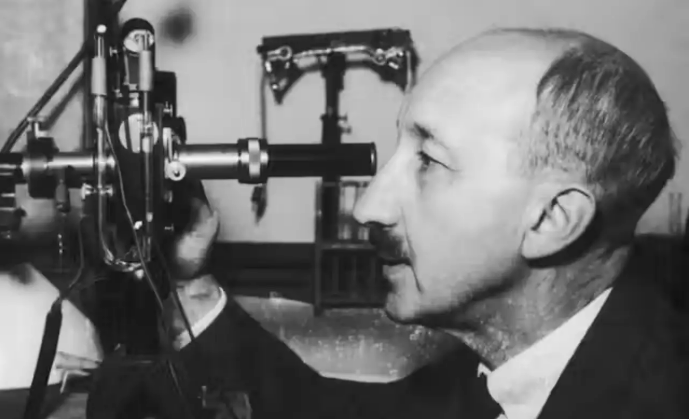
Have you ever wondered how doctors know what’s going on inside our bodies without opening us up? Or how scientists discover how plants absorb nutrients? The answer to these questions has a name: George de Hevesy, and a key date: 3 June 1923.
One problem, one brilliant solution
In the early 20th century, science faced an invisible barrier. Biologists wanted to know how atoms and chemicals moved within a living organism (be it a plant, an animal, or a human being). Still, there was no way of doing so without destroying the organism in the process.
George de Hevesy, a Hungarian chemist with an insatiable curiosity, had a revolutionary idea: what if we used radioactive isotopes as ‘tags’?
If we label a chemical substance with a radioactive isotope, we can track its path through an organism using a radiation counter, as if we were carrying an atomic GPS.
The Bean Experiment (1923)
On 3 June 1923, Hevesy published the results of a simple yet masterful experiment. He used a tiny amount of radioactive lead to study how broad-bean plants absorbed nutrients from the soil.
Hevesy demonstrated that it was possible to track the path of that lead from the roots to the leaves. The method of radioactive tracers was born. It was the first time that humankind had managed to observe a metabolic process in real time and in a living organism.
From the factory to the hospital
Although it began in botany, the impact of this discovery was enormous:
- Nuclear medicine: Today, thanks to Hevesy, we are able to perform PET scans or scintigraphy. We inject a small amount of a radioactive substance (a tracer) into the patient and, using a special camera, we can ‘see’ where it accumulates, enabling us to detect tumours or heart problems with pinpoint accuracy.
- Biochemistry: It has enabled us to understand how the body synthesises proteins, how our hormones work and how we react to drugs.
A well-deserved Nobel Prize
George de Hevesy was awarded the Nobel Prize in Chemistry in 1943. The most curious aspect of his story is that, during the Second World War, he had to hide his Nobel gold medal from his colleagues (Max von Laue and James Franck) by dissolving it in aqua regia (a corrosive acid) in his laboratory in Copenhagen. After the war, he recovered the gold from the solution and the Nobel Foundation recast his medals.
Why is it important today?
George de Hevesy taught us that radiation, far from being something we should simply fear, is one of the most powerful tools for human knowledge. His ‘atomic GPS’ continues to guide today’s doctors and help scientists understand the secrets of life.
If you’d like to find out more about this scientist, click on the link below: George de Hevesy
