Nuclear energy guarantees water availability and sustainable water management
Access to safe drinking water, sanitation, and hygiene represents the most fundamental human need for healthcare and well-being. However, billions of people will not have access to these basic services by 2030, due to pollution, excessive water use, climate change, rapid population growth, urbanisation, and the growing water needs of the agricultural, industrial, and energy sectors.
According to the report ‘Nuclear’s Contribution to Achieving the UN Sustainable Development Goals’, prepared by the Canadian Nuclear Association, FORATOM (now Nucleareurope), Japan Atomic Industrial Forum (JAIF), Nuclear Energy Institute (NEI), Nuclear Industry Association (NIA) and the World Nuclear Association (WNA), nuclear technology contributes to the achievement of the 17 Sustainable Development Goals (SDGs) and 169 targets set out in the ‘2030 Agenda for Sustainable Development’ established by the United Nations in 2015.
These objectives and targets are integrated and indivisible, and combine in a balanced manner the three dimensions of sustainable development: economic, social, and environmental.
Therefore, on the issue at hand, Sustainable Development Goal 6 (SDG 6) has established the following targets for 2030:
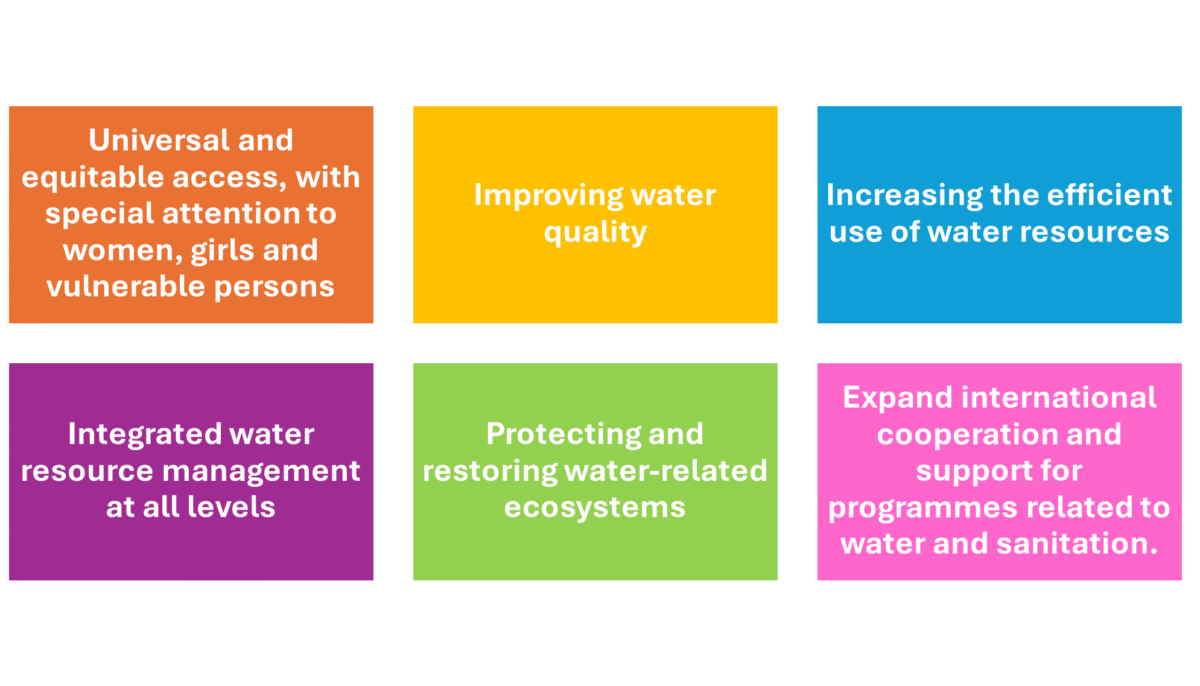
In this context, nuclear energy has emerged as a promising tool for addressing the global water crisis and advancing towards the achievement of SDG 6 worldwide:
- Water desalination. This process utilizes nuclear energy to generate heat, which converts seawater into steam, leaving behind salt and other impurities. The steam is then condensed, producing drinking water suitable for human and agricultural consumption. This technology has proven crucial in arid and coastal regions where fresh water is scarce but access to seawater is abundant. It also provides clean water without the greenhouse gas emissions produced by desalination units that use fossil fuels.
- Wastewater treatment. Electron beam irradiation can destroy certain contaminants present in wastewater, allowing it to be safely reused or returned to the environment without posing a risk to public health.
- Tracking sources of water pollution. Excess nitrate in lakes, seas, and rivers can increase algae growth, with the risk of toxic blue-green algae or cyanobacteria blooms. Nuclear technology can be used to identify the source of pollution economically, quickly, and safely, distinguishing whether it comes from agriculture, sewage systems or industry.
- Monitoring and management of water resources. They use natural isotopes present in water to determine the origin of water, its age, and its vulnerability to contamination, as well as how water resources move and interact with each other on and below the surface. They are also used to understand the effects of climate change better, adapt to it, and map available water resources, including aquifers hidden below the surface. This enables better management of river basins and more accurate planning for the long-term sustainability of water resources.
If you would like to know more, take a look at the article: ‘Nuclear technology, essential for achieving the Sustainable Development Goals’.


