Rhinoisotopes, an effort to combat rhino poaching
South Africa, home to the world's largest rhino population, continues to attract criminals engaged in poaching for the illegal trade in rhino horns, resulting in the loss of more than 10,000 rhinos in the last decade.
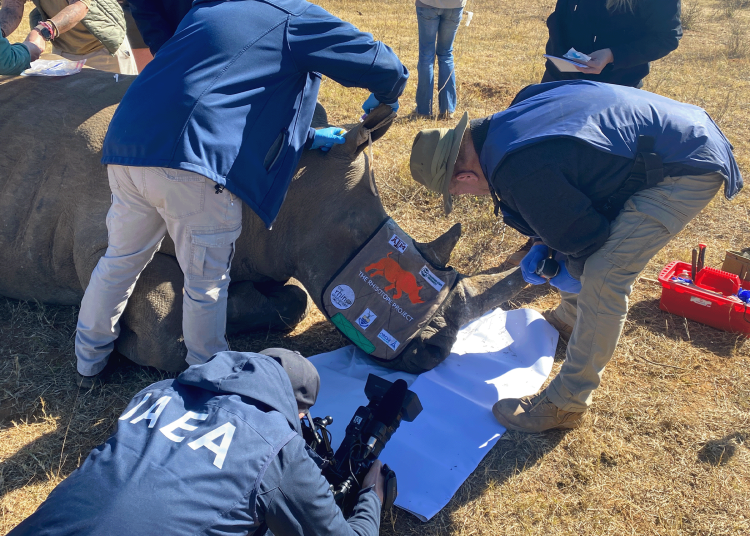
In an effort to protect this endangered species, the University of the Witwatersrand in South Africa launched the ‘Rhinoisotopes’ project, supported by the International Atomic Energy Agency (IAEA), which combines the safe insertion of radioactive isotopes into rhino horns to deter and detect this illegal practice.
To this end, rhino horns are marked with radioactive material, thanks to which they can be detected by the 10,000 radiation detection gates already installed at borders, ports, and airports around the world.
After two years of digital modelling of the project, safety tests, and detection simulations, last year, a further step was taken, and radioisotopes were inserted into 20 rhinos. The University of Ghent (Belgium) is responsible for monitoring the health and cytological examinations of 15 treated animals, as well as comparing them with five untreated animals. One year on, the results of the trials have shown that the method is non-invasive and poses no risk to the rhinos' health.
The success of the project lies not only in the use of radiation for protection, but also opens the door to future applications in other endangered species, such as elephants and pangolins.
For its part, the IAEA is providing technical and financial support within its research project ‘Facilitating technologically and physically secure trade through nuclear detection technology, in particular the detection of radioactive and nuclear material and other types of contraband’.
If you would like to see videos or photographs of this project, click here.
News source: International Atomic Energy Agency (IAEA)