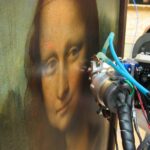
X-rays can reveal the secrets of a cultural, artistic or historical object.
Since the discovery of nuclear energy, many applications have been developed, such as producing electricity, diagnosing and treating diseases, caring for the environment, etc. However, one of them is little known: the study, conservation, restoration, and disinfection of cultural, artistic, or historical heritage.
In this article, we focus on how the use of X-rays can help unlock the secrets of a cultural, artistic, or historical object, but if you want to know more about what else can be done, take a look at our article: What can nuclear technology do for artistic, cultural and historical heritage?
Characterization is a process that allows experts to examine the properties of archaeological or artistic objects with high accuracy, as well as to find out their age, chemical composition, and geographical origin and diagnose problems. It is not a single method, but multiple nuclear techniques using different types of equipment and radiation, such as X-rays, gamma rays, neutrons, and ion beams.
The information gathered not only ‘speaks’ of the object but can also determine whether a work of art is genuine or forged, and detect possible problems such as cracks, fractures, or defects that are not visible to the naked eye and which compromise its conservation.
The techniques presented below are non-destructive and their main uses are:
- Analyze the internal structure and integrity of cultural heritage objects, revealing internal structures, cracks, previous repairs, and construction techniques.
- Analyse paint layers, revealing underlying layers, modifications, and hidden details that are not visible to the naked eye.
- Identify filler materials used in previous restorations, which is crucial for employing appropriate conservation methods.
- Although not directly used as a technique for disinfecting objects, it can help to identify the presence of micro-organisms or pests within objects, facilitating the planning of more suitable disinfection treatments.
- It can reveal inconsistencies in the internal structure of objects that could indicate counterfeits.
- It can sometimes help identify hidden signatures or markings on works of art, providing additional evidence of authenticity.
X-ray fluorescence (XFR)
This non-destructive analytical technique, known as XFR, is used to analyze the elemental chemical composition of objects such as paintings, manuscripts, coins, and ceramics, without removing samples.
It involves ‘bombarding’ a sample with X-rays to destabilize the structure of the electrons and cause them to emit radiation. Since the radiation is different for each chemical element, its chemical composition can be accurately established.
One of the advantages offered is that it can be applied with a small device in the form of a gun, which makes it easy to transport, especially in the case of works that cannot be moved, such as frescoes or large sculptures.

Examples of the use of this technique include:
- Identification of the pigments used in Leonardo Da Vinci's paintings in 9 of his works (The Virgin of the Rocks, Saint John the Baptist, The Annunciation, Bacchus, the Mona Lisa, La Belle Ferronnière, Saint Anne, the Virgin and Child). In the case of the Mona Lisa, XFR revealed that, in addition to lapis lazuli, other colors made with cobalt were also present, which were not used until some time after the artist's time, indicating that the work was retouched at a later date.
- They also analyzed the composition and thickness of the different layers of paint and varnish and were able to learn more about his technique of ‘sfumato’, a fine shading that creates smooth transitions between colors and makes the work more believable.
- In the study of ancient bronze statues, XFR has been able to identify the proportions of copper, tin, and other elements, providing information on the casting techniques used in different historical periods.
- XFR has been used to analyze pre-Columbian ceramics, helping archaeologists to determine the sources of materials and ancient trade routes.
- The Birmingham Museum of Art uses a portable XFR scanner to analyze works of art, including authentication and identification of heavy metals (which are toxic). As an example, it has been used to reveal that the frame of a 19th-century painting is made of copper and not gold as suspected.
- The Vienna Museum of Art History applied XFR to detect in Indonesian kris daggers traces of ore from a meteorite that fell in the area in the 18th century.
In addition to XFR, other complementary techniques can be used to extend the information obtained from the objects. These are the most important ones:
- Raman spectroscopy. Used to identify molecules and crystalline structures in cultural materials. It is especially useful for pigments and organic materials.
- Computed Tomography (CT). Provides detailed three-dimensional images of the interior of objects, which is useful for studying their internal structure and detecting hidden damage.
- Infrared spectroscopy. Used to identify organic and inorganic materials in cultural objects. It is especially useful for analyzing paint layers and filler materials.
- X-ray diffraction (XRD). Analyses the crystalline structure of materials, providing information on their composition and state of preservation.
- Scanning Electron Microscopy (SEM). Enables high-resolution images to be obtained of the surface of objects, revealing microscopic details about their composition and structure.
- Ultrasound. Used to detect cracks and other internal defects in solid materials such as stone and metal.
Industrial radiography


Analyzing the internal structure and integrity of cultural heritage objects, revealing internal structures, cracks, previous repairs, and construction techniques.
It involves passing X-rays, gamma ray,s or neutrons through them and when the radiation comes into contact with an exposed film or a specifically designed digital camera placed on the other side, the radiation creates an image of what is hidden, including defects or cracks inside.
In the image, X-rays of Picasso's ‘The Old Blind Guitarist’, one of the most famous works of the blue period, revealed that the painter had reused an old canvas. Underneath the painting were two compositions he had created earlier: an old woman with her head bent forward and a young mother with a child kneeling beside her.
Another example is the analysis of Vincent van Gogh's ‘Portrait of a Peasant Girl’ in the National Galleries of Scotland, which uncovered a hidden self-portrait of the painter. This does not seem strange as the artist often reused canvases to save money, turning them over and then working on the other side. Conservators have the job of uncovering the self-portrait under layers of adhesive and cardboard, preserving the original paint. Why was this done? It is believed that 15 years after his death, it was loaned for an exhibition at the Stedelijk Museum in Amsterdam and it was during the loan that the canvas was glued to the cardboard before framing as the peasant girl was considered to be more ‘finished’ than the self-portrait.

(Source: National Galleries of Scotland)
It is not only applied to paintings, bronze statues have been studied to see internal cracks and know the method of manufacture, and ceramic pieces and other artifacts to identify how they have been manufactured and if they have undergone restoration.
In addition to industrial radiography, other complementary techniques are used, such as:
- X-ray fluorescence (XFR).
- Computed Tomography (CT).
- Infrared spectroscopy.
- Ultrasound.
- X-ray diffraction (XRD).
- Ultraviolet light (UV). Helps to identify previous restorations and added materials, as some of them have the property that they fluoresce under ultraviolet light.
These methods, together with in situ radiography, provide a comprehensive view of the condition and composition of cultural objects, enabling conservators and restorers to make informed decisions about their treatment and preservation.
X-ray diffraction (XRD)

It is an advanced system used to analyze and understand the materials, age, and provenance of ancient objects without touching them, thus eliminating the risk of contamination. Knowing this information allows the identification of the most appropriate conservation methods for relics.
It is a non-destructive and highly sensitive technique, allowing the investigation of a few particles or milligrams of material, making it less intrusive than other methods.
Crystalline material is exposed to X-rays, and as the X-rays interact with the atoms in the crystals of the material, they scatter and produce an interference effect, called a diffraction pattern. This pattern can provide information about the crystal structure or identity of a crystalline substance, helping scientists to accurately characterize and identify the crystal structure of an object.
In XRF applications, analysts receive peak prints (much like an electrocardiogram) that tell the story of the composition of the material being examined. The horizontal axis reveals the elements of the object and the height of the peaks gives the percentage of material present.
In detail, it is used for:
- Identify crystalline compounds present in objects, providing information on their composition and origin.
- Analyse pigments in paintings and ceramics, helping to determine the techniques and materials used by the artists.
- Provide information on original materials and those used in previous restorations, helping conservators to better plan interventions.
- Identifying changes in the crystalline structure of materials due to deterioration processes, is crucial for planning conservation strategies.
- It is not directly used for disinfection, however, it can help to identify the presence of salts and other compounds that could favor the growth of microorganisms, facilitating the planning of more appropriate disinfection treatments.
- Reveal inconsistencies in the crystalline structure of objects that could indicate counterfeits.
- Compare the crystalline structure of objects with known reference materials, providing additional evidence of authenticity.
Some examples of the application of this technique are:
- Analyse archaeological ceramics, helping to determine their origin and the manufacturing techniques used.
- Study the pigments in paintings, providing information on the materials and techniques used by the artists.
- Analyze the patina of bronze statues, helping to determine their composition and state of conservation.
- The Saliera by Cellini. This 30 cm statue of 90% pure gold is of great historical value because it was sculpted during the Renaissance to contain the salt used in royal feasts, showing the graceful bodies of a man and a woman symbolizing the god of the sea and the goddess of the earth. It is worth more than $60 million. After its highly publicized theft in 2003, Austrian police spent nearly three years searching for the thieves, before receiving a tip-off in early 2006 that the art treasure was buried in a bag in the forests of northwestern Austria. Using XRF, restorers have been able to analyze the statue for hidden damage, verify its authenticity, and how to go about repairing the damage sustained during the theft and its subsequent conservation.
- Examining the nose of Michelangelo's David so that it could be safely restored.
- Examining the right knee of Cellini's bronze statue of Perseus in the Uffizi Museum in Florence (Italy) to learned that it was made of a bronze alloy with varying percentages of copper, tin, lead, antimony, iron, and silver.
Along with XRD, several complementary methods are used for the study, conservation, restoration, disinfection and authentication of cultural heritage, offering a comprehensive view of the state and composition of cultural objects. The most common are:
- X-ray fluorescence (XRF).
- Raman spectroscopy. Used to identify molecules and crystalline structures in cultural materials, especially useful for analyzing pigments and organic materials.
- Infrared spectroscopy. Used to identify organic and inorganic materials in cultural objects, particularly for analyzing paint layers and filler materials.
- Scanning Electron Microscopy (SEM). Enables high-resolution images to be obtained of the surface of objects, revealing microscopic details of their composition and structure.
- Computed tomography (CT).
- Neutron activation analysis (NAA). Determines the elemental composition of objects by neutron irradiation and measurement of the induced radioactivity.
Computerized Tomography (CT)
It is a non-destructive technique that provides detailed three-dimensional images of the interior of objects by using X-rays and is therefore useful for studying their internal structure, detecting hidden damage, restorations, etc.
The X-ray source emits a beam towards the object and a receiver makes the measurements, rotates a certain angle, and repeats the process. Subsequently, all the images are averaged and a cross-section or cross-section is obtained using computer calculation programs.
Each cross-sectional image can be studied separately or a three-dimensional image of the object can be created from all the information.
Examples of the use of this technique include:
- The study of Inca mummies found in the Llullaillaco volcano, reveals details about their state of preservation and the environmental conditions that favored their preservation.
- The study of human fossils in Atapuerca (Spain) using computerized tomography has made it possible to obtain detailed images of the bone remains without damaging them.
- The analysis of ancient wood carvings, identifying internal cracks, and construction techniques used by the craftsmen.
- The analysis of a mummy of the Egyptian priest Ankhekhounsu who lived 3 billion years ago by Italian researchers.

In detail, we have the example of the analysis of the mummy of the Egyptian priest Ankhekhonsu who lived 3 billion years ago.
It was transferred from the Civic Archaeological Museum of Bergamo to the Policlinico Hospital in Milan. At the site, the ‘Mummy Project team and Policlinico's Radiology team carried out a computerized tomography scan from which analyses were obtained to reconstruct part of his life and death.
The images obtained will also allow for the forensic reconstruction of her face.
In addition to CT scans, several complementary methods are used to provide a comprehensive view of the condition and composition of cultural objects, allowing conservators and restorers to make informed decisions about their treatment and preservation. The most common are:
- X-ray fluorescence (XRF).
- Raman spectroscopy
- Infrared spectroscopy
- X-ray diffraction (XRD)
- Scanning Electron Microscopy (SEM)
- Ultrasound
Non-destructive testing (NDT) and non-destructive analysis (NDA)

In Albania, X-rays have been used to discover the painter of the century-old portrait of St George, one of the most famous saints of Christendom.
Using these two methods, both based on X-rays, it was possible to study the materials and quality of the object, the integrity and physical properties without damaging it, the interior and to detect any cracks or flaws that would otherwise not be visible.
An XFR was then applied to determine the materials used and compare them with those used by different artists at different times, and the analysis showed a coincidence: the Çetiri brothers in the 18th century were the authors.
If you'd like to learn more about nuclear techniques applied to preserving cultural heritage, including examples, you can consult this publication by the International Atomic Energy Agency (IAEA) entitled: "Uses of Ionizing Radiation for Tangible Cultural Heritage Conservation"