Disinfection and cleaning of historical artefacts using nuclear techniques
Since the discovery of nuclear energy, many applications have been developed, such as producing electricity, diagnosing and treating diseases, caring for the environment, etc. However, one of them is little known: the study, conservation, restoration, and disinfection of cultural, artistic, or historical heritage.
In this article, we focus on nuclear science and technology applied to the disinfection and cleaning of historical works and objects. However, if you want to know more about what else can be done, take a look at our article: What can nuclear technology do for artistic, cultural, and historical heritage?
The long-term preservation of unique and irreplaceable historical objects can be a difficult task, as inadequate storage conditions can lead to the growth of bacteria, insects, or other animals on the surface or inside the objects, as well as mold or other fungi, resulting in the deterioration or complete destruction of the objects.
Use of ionizing radiation
By using ionizing radiation, it is possible to clean and disinfect historical works and objects affected by different types of parasites such as insect pests, pathogenic bacteria, fungi, etc.
For this purpose, with the help of a particular device, e.g. high-energy electron beam accelerators, X-ray machines, or gamma radiation processing facilities (the only gamma irradiator in the world dedicated to heritage conservation is owned by ARC-Nucleárt) containing radioactive sources of cobalt-60 or cesium-137, energy is transferred to the micro-organisms residing on the object through ionizing radiation, altering their DNA without affecting the rest.
There are two different dose levels: a lower one for insects (which have more complex DNA susceptible to radiation damage) and a higher one for molds.
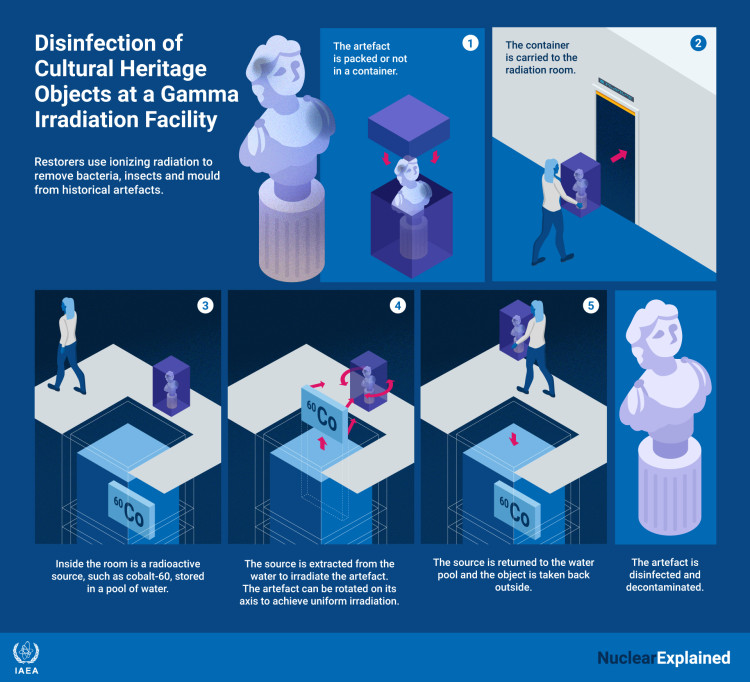
Treatments can last several days and reach a dose of 10 kGrays.

The first known example of applying this technique, with gamma radiation, in 1977, to the 3,200-year-old mummy of the Egyptian Pharaoh Ramses II. It was infested with some 60 species of fungi. He was exposed to 18 kilograys.
Since then it has been in common use and there are many other cases such as the neutralization of germs that were affecting the soft tissues of Khoma, a 50,000-year-old mammoth that was found frozen in the permafrost of Siberia, books in the library of the Peace Palace in the Netherlands, film reels in the Romanian National Film Archive or wooden iconostases in the sacred vaivode of the church of Michael and Gabriel in Romania.
It is important to remember that materials treated with ionizing radiation do not become radioactive and are not damaged. The restorers use small doses of radiation, limited to a maximum of 10 kilo-grays, so the objects remain the same, except that they are now only disinfected.
Advantages of using irradiation over other methods
Typically, experts have employed chemical and physical methods to disinfect cultural and historical objects that involve toxic substances or heat treatments that can be harmful to the objects, the restorers and the environment. They are also costly and none of them can guarantee full eradication of pests.
In comparison, applying irradiation techniques has several advantages:
- The possibility of mass processing
- No temperature effects
- No physical contact with the object
- No need to use additional substances
- No traces are left.
- No damage to the treated materials.
- Risks can be minimized by carrying out radiation decontamination in well-protected areas under strict safety conditions.
- No residues
Nuclear techniques are available to combat these problems. By impregnating it with a monomer (a small molecule) and then irradiating it with gamma rays, it is possible to produce the consolidation of the work through polymerization (a chemical grouping of compounds) while at the same time eliminating insect contaminants from the work through sterilization.
If you would like to know more about nuclear techniques applied to the conservation of cultural heritage with examples, you can consult this publication by the International Atomic Energy Agency (IAEA) entitled: "Uses of Ionizing Radiation for Tangible Cultural Heritage Conservation"