The Highways of Electricity: High-Voltage Transmission
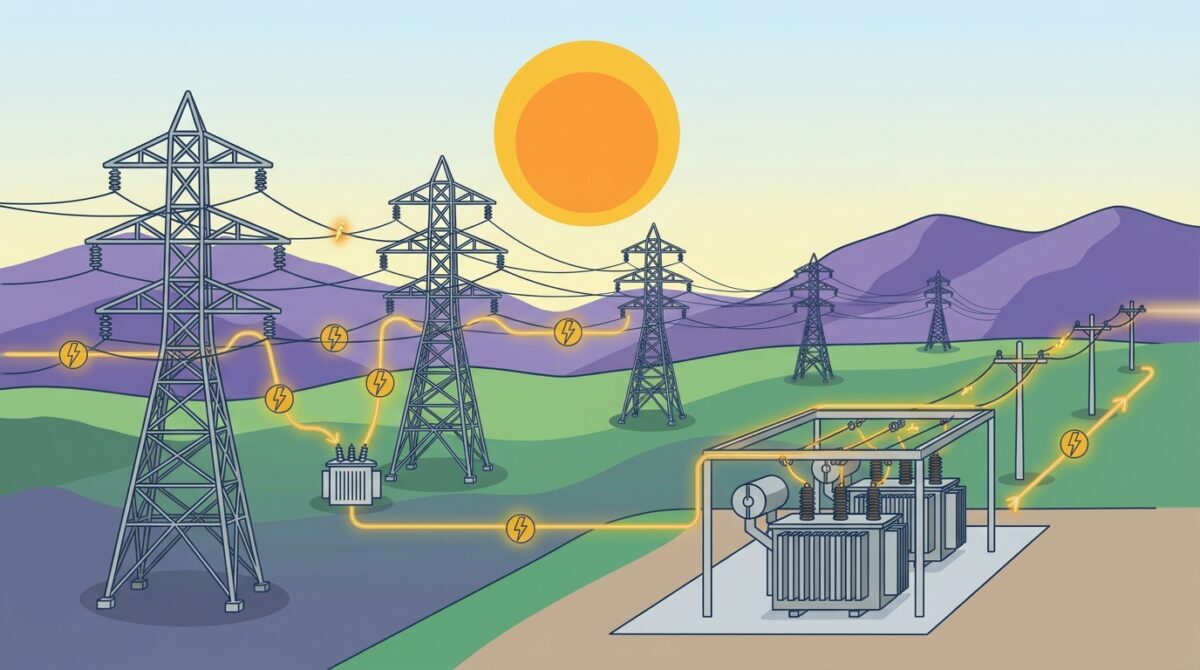
Large power generation plants are rarely located inside cities. Wind farms sit atop windy mountain ranges, solar farms cover large, sunny expanses, dams are built along river courses, and nuclear power plants are generally located near water sources for cooling. This means electricity must be transmitted over hundreds of kilometers to reach homes and factories.
If we sent that electricity at the same voltage we use at home (230 volts), a physical disaster would happen: moving that much energy would require a very high electric current, which would heat the cables until they melted, and almost all the energy would be lost along the way as heat. In physics, this phenomenon is known as the Joule effect (heat or thermal energy (Q) measured in joules equals electric current (I) squared measured in amperes multiplied by electrical resistance (R) measured in ohms and by time (t) measured in seconds).
To prevent these losses, power plants have step-up transformer substations at their output. These facilities increase the voltage of electricity to 220,000 or 400,000 volts (400 kV), which is what we call "High Voltage." By multiplying the voltage by a thousand, the electric current is divided by a thousand to transmit the same power, reducing losses to a minimum and allowing lighter cables to be used.
This transmission network works like the major highways of energy. In Spain, the entire high-voltage transmission grid—more than 45,000 kilometers of lines crossing mountains, connecting the mainland to the islands via submarine cables, and linking with France, Portugal, and Morocco—is operated exclusively by a single entity: Red Eléctrica (part of the Redeia group).
The heart of this system is the CECOEL (Electrical Control Center), located in Madrid. From there, engineers monitor the grid 24 hours a day, 365 days a year, maintaining a millimetric balance measured through the grid frequency: 50 hertz (Hz). If demand rises and energy sources do not compensate immediately, generators slow downn, and the frequency drops below 50 Hz; if there is excess energy, they speed up, and it rises. A major deviation would trip automatic protections, causing a system blackout or national power outage.