NASA Successfully Completes Tests of Its Cold‑Flow Nuclear Engine Prototype
NASA has reached a milestone in the space race with this technological breakthrough — the first of its kind since the 1960s — which promises to double the efficiency of current rockets and open the door to interstellar missions.
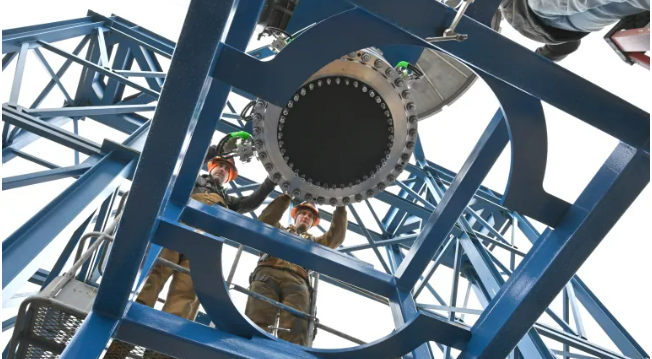
NASA’s Marshall Space Flight Center in Huntsville, Alabama, has completed, as part of its DRACO program, a series of critical tests on a prototype nuclear reactor designed to propel spacecraft beyond Jupiter and, in the future, out of our solar system.
Throughout 2025, more than 100 tests were carried out on a barrel‑sized engineering development unit of about 378 liters. The system simulates how liquid hydrogen propellant would flow through a real nuclear reactor powering a spacecraft.
These tests, conducted in collaboration with BWX Technologies, focused on what is known as “cold‑flow” testing. Unlike a full nuclear reaction, this procedure uses a full‑scale model to simulate how hydrogen propellant behaves as it travels through the reactor core — without using radioactive materials. The goal is to verify that the design can withstand the destructive vibrations and extreme pressure waves that occur during real operation, thereby validating the mathematical models that will guide future NASA missions.
Not since the 1960s has such precise data been obtained for a flight‑capable space reactor design. These results not only confirm the project’s viability but also strengthen the technological foundation needed for nuclear thermal propulsion to become the standard for long‑distance space travel.
The significance of this achievement lies in its ability to overcome the limitations of conventional chemical propulsion. While current engines rely on combustion reactions that rapidly deplete fuel, this new system uses nuclear fission to heat hydrogen, enabling an efficiency twice that of today’s best rockets. This would drastically reduce travel times to destinations such as Mars — meaning less exposure to cosmic radiation for astronauts, reduced life‑support requirements, and crews arriving with far less fatigue. For robotic missions to the outer solar system, nuclear propulsion could enable entirely new categories of science that are simply not feasible with current technology.
Collaboration with industrial partners such as General Atomics has also been crucial, as it is essential to verify that the specialized nuclear fuel can withstand the extreme operating conditions expected.
Original article: NASA Testing Advances Space Nuclear Propulsion Capabilities