February 18, 1745 – Birth of Alessandro Volta, inventor of the electric battery
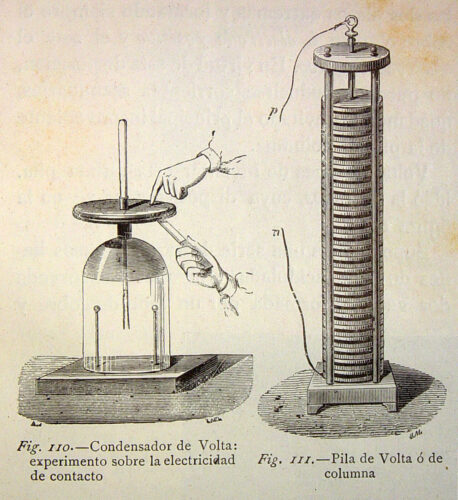
He studied physics and chemistry and, in 1774, began working as a physics teacher at the Royal School in his hometown of Como, Italy. A year later, Volta made his first invention, the perpetual electrophorus, a device that produced direct electric current using three metal discs separated by a wet conductor but connected by an external circuit. Once charged, it could transfer electricity to other objects and generate static electricity.
Between 1776 and 1778, he devoted himself to chemistry, discovering and isolating methane gas.
In 1794, Volta, based on the idea of his friend Luigi Galvani that two different metals in contact with a frog's muscle caused it to contract and that this must be due to the appearance of an electric current, also began to conduct his own experiments, concluding that animal muscle tissue was not necessary to produce an electric current.
Two schools of thought emerged on this subject: supporters of animal electricity and defenders of metallic electricity, which generated a fierce controversy that was resolved when Volta managed to build his first electric battery on March 20, 1800, proving his hypothesis.
Volta wrote a letter to Sir Joseph Banks, then president of the Royal Society of London, to announce his invention, which was read before the society's members on June 26 of that same year. After repeating the invention several times, Volta's electric battery was confirmed and credited.
If you want to know more about this scientist, click on the following link: Alessandro Volta
