What Is the Power Term?
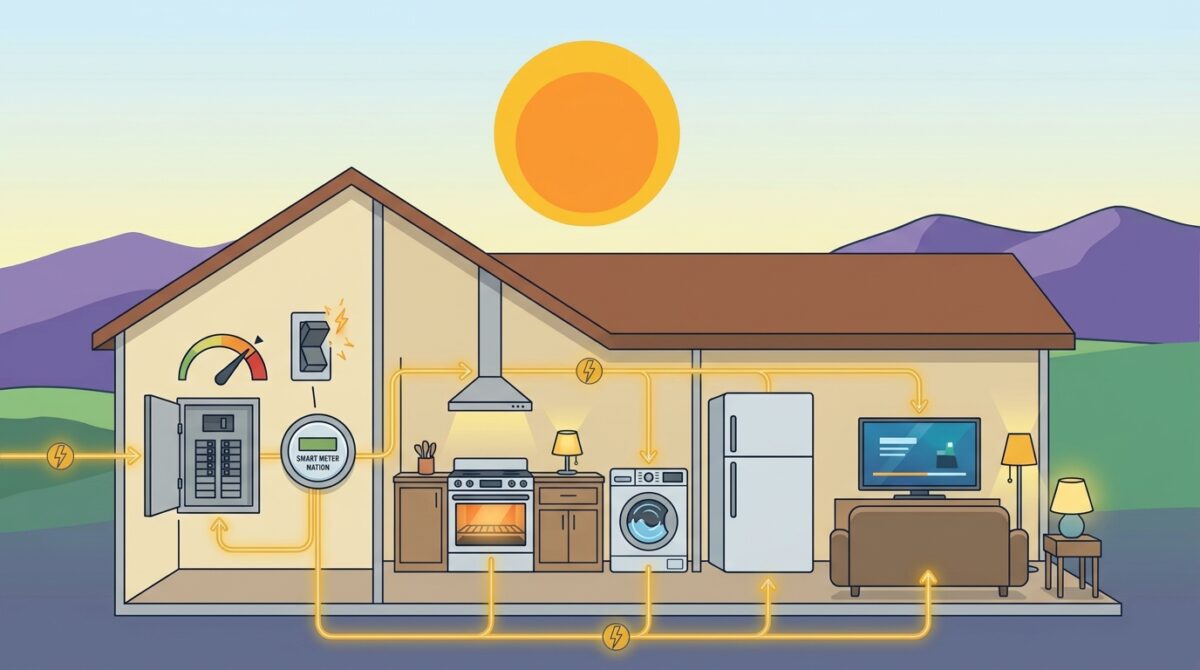
When you open any electricity bill in Spain, the total amount is structured into two main blocks: a fixed part that you pay every month regardless of whether you are at home or on vacation, and a variable part that depends on how much you turn on appliances. That fixed part is called the "Power Term."
In physics, electrical power—measured in watts (W) or kilowatts (kW, where 1 kW = 1,000 W)—indicates the amount of energy an appliance demands for every second it is running. Each appliance has a different power rating depending on the effort it makes:
- A phone charger or an LED bulb barely requires between 10 W and 20 W (0.01 - 0.02 kW).
- A modern television is around 100 W - 150 W (0.1 - 0.15 kW).
- Appliances that generate intense heat or cold are the ones that demand the most power: an oven, an induction cooktop, a washing machine heating water, or a hair dryer demand around 2,000 W or 2,500 W (2 - 2.5 kW) each.
The Power Term that appears on your bill represents the "maximum flow rate" of electricity you have contracted so you can use several appliances at once. It is paid by multiplying the contracted kilowatts by the days in the billing period and by the daily price of each kilowatt.
What happens if you go over the limit? Inside all modern digital meters, there is a device called an ICP (Power Control Switch). If you have contracted 3.45 kW and turn on the oven (2 kW), the washing machine (1.5 kW), and the microwave (1 kW) at the same time, the total reaches 4.5 kW. Upon detecting that you exceed your contracted limit, the meter automatically cuts the power to the entire home to protect the grid. This is popularly known as "tripping the breakers." To reset it, simply turn off one of the appliances, flip down the main switch on your home's electrical panel for 3 seconds, and flip it back up (on some meter models, you can also reset it from the meter's own button).
Adjusting your contracted power level is one of the most direct ways to save money: many families pay every month for a power capacity much higher than what they actually need daily.
Related content:
 May 24, 2019 – Death of Murray Gell-Mann, Nobel Prize who coined the term quark and classified elementary particles
 July 4, 1934 - Death of Marie Curie, coined the term radioactivity and isolated the chemical elements radium and polonium
 November 7, 1867 - Birth of Marie Curie, coined the term radioactivity and isolated the chemical elements radium and polonium