Power Distribution Companies
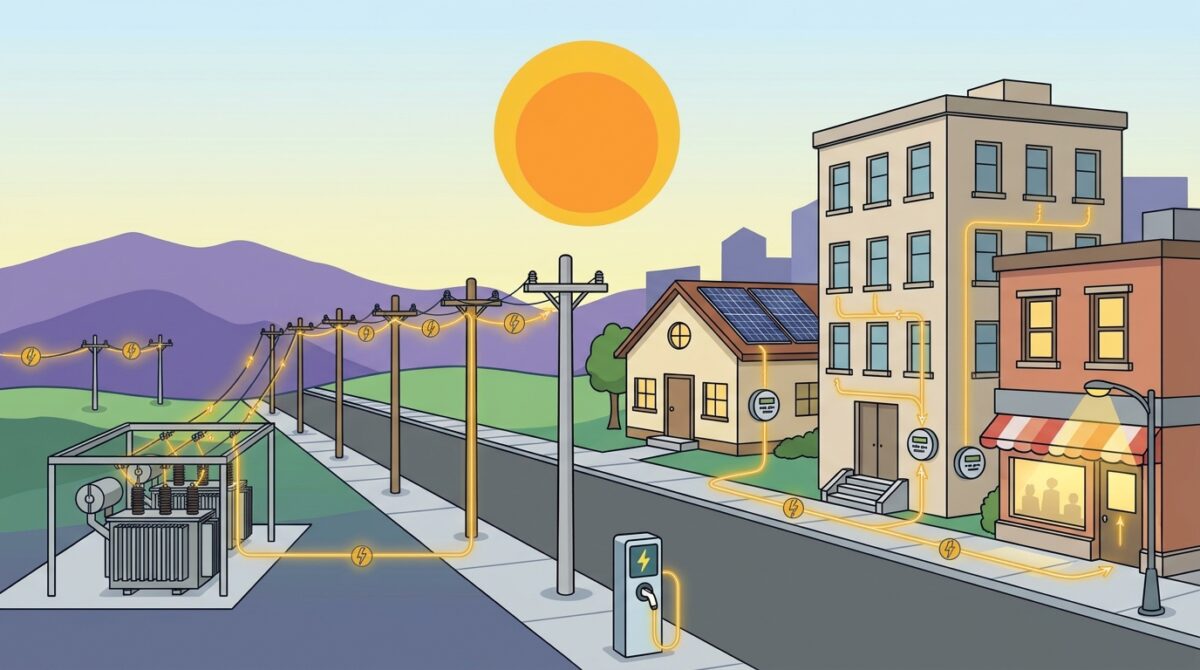
When electricity reaches the outskirts of a city, traveling at 400,000 volts along high-voltage transmission highways, it cannot be fed directly into a building or a school, for example, as it would pierce any household insulation without difficulty. It needs to gradually step down in voltage and branch out to reach every street and every doorway.
This is where distribution companies come into play. If the transmission grid is the national highway, the distribution grid is equivalent to regional roads, avenues, and neighborhood streets. Distribution companies own the entire local power line network (both overhead in rural areas and underground in cities), urban substations, and the smart meters installed in building meter rooms.
Stepping down the voltage to your outlet happens in two main stages:
- From High to Medium Voltage: At substations located on the outskirts of cities, large transformers reduce the voltage from 220–400 kV to between 1,000 and 30,000 volts (1–30 kV). Large consumers such as hospitals, factories, shopping centers, or the metro—which have their own internal transformers—are fed directly from this medium-voltage grid.
- From Medium to Low Voltage: Inside each neighborhood, every few blocks, there are small transformer stations (often built into the ground floors of buildings or inside metal cabinets on sidewalks). That is where the final reduction takes place down to 230 volts (for single-phase residential supplies) or 400 volts (for three-phase supplies in workshops or elevators). From there, electricity enters through the building's service line, passes through the meter, and reaches the outlets in your home.
In Spain, electricity distribution is a regulated activity (a natural monopoly, since it would be absurd and prohibitively expensive for five different companies to dig trenches in your street to lay five parallel cable networks). Because of this, you cannot choose your distribution company: you are assigned the one operating in your geographic area (such as i-DE across much of the north and center, e-distribución in the south and Catalonia, UFD in Galicia and Madrid, or E-Redes). If the power goes out across your entire street due to a fault or a storm, it is the distribution company that sends its technical crews to fix it.


