Robert Bowie Owens and the mystery of the draft that opened the doors to modern physics
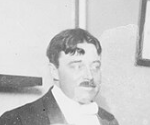
October 29, 1870, Maryland (United States) - November 3, 1940, Maryland (United States)
Raised in Maryland, Owens showed an early and brilliant aptitude for technological sciences. He studied at the Industrial College of Johns Hopkins University and later at Columbia University. At 21, in August 1891, he was hired as an adjunct professor of electrical engineering at the newly created department of that specialty at the University of Nebraska-Lincoln. During his time there, he actively participated in the founding of the society that would later become the prestigious IEEE (Institute of Electrical and Electronics Engineers).
The Milestone at McGill with Rutherford
In 1898, Owens moved to Montreal after accepting the prestigious MacDonald Chair of Electrical Engineering at McGill University in Canada. It was during this period that his path crossed with New Zealand physicist Ernest Rutherford. Joining forces to unravel the nature of radioactivity, Owens focused on studying thorium emissions. It was his experimental rigor that led him to notice that ordinary air currents drastically altered the radioactivity readings of this element—a finding that would change the course of modern physics.
The Thorium Experiment and the Mystery of the Wind
To study thorium oxide radiation, Owens used an ionization chamber connected to an electrometer. The principle was simple: the radiation emitted particles that electrically charged the air inside the chamber, and the electrometer measured that electric current. The more radiation, the higher the detected current. However, the experiment became a headache due to a series of curious events:
- The mystery of the open doors: Owens noticed that measurements were completely unstable. After exhaustive investigation, he discovered that the sample's radioactivity changed drastically whenever someone opened the laboratory door, walked past quickly, or when a slight breeze blew inside the room.
- The invisible "smoke": To confirm whether the air was carrying "something" away, he built a special wooden box to protect his detector. He then installed a bellows to pump air in a controlled manner. He discovered that blowing air over the thorium made the radioactivity in the detector almost completely disappear, but leaving the air calm allowed it to recover gradually. It was as if the thorium was releasing an invisible gas that the wind was carrying away.
- The role of paper: To try to block this supposed current, Owens covered the sample with several sheets of paper. Surprisingly, the radioactive gas kept filtering through the paper fibers and altering the measurements when the air blew.
The Alliance with Rutherford and the Discovery of Radon
Baffled by this behavior, Owens showed his chaotic results to Ernest Rutherford. Rutherford, who at the time was focused on uranium (which has very stable radiation unaffected by wind), was fascinated. Rutherford took over Owens's research and built a system of tubes to "vacuum" that thorium-modified air and pass it into another container. Thus, they discovered that thorium was emanating a highly radioactive noble gas—initially called "thorium emanation" (and historically known as thoron), which we identify today as the isotope radon-220. Most fascinatingly, they verified that this gas lost half of its radioactivity in barely a minute (its half-life is 55.6 seconds). Owens's sensitivity and curiosity in the face of a simple air current shattered the era's idea that radioactivity was a fixed and static process, providing Rutherford with the necessary evidence to consolidate the properties of alpha rays and open the door to modern nuclear physics.
Later Career and Military Service
Following his historic research period in Canada, Owens returned to the United States, where he continued to expand his influence in scientific and social spheres:
- Franklin Institute: He served as secretary general of this prominent scientific institution in Philadelphia between 1910 and 1924.
- World War I: He served in the U.S. Army under General John J. Pershing. With the rank of Major, he assumed responsibility for directing the telephone communications of the American Expeditionary Forces (A.E.F.) on the European front. For his valiant services, the British government awarded him the prestigious Distinguished Service Order (D.S.O.) medal.
- Later Years: Afterwards, he served as director of the Maryland Academy of Sciences. After battling a long illness during his final years, he passed away at the age of 70 in Sykesville.

