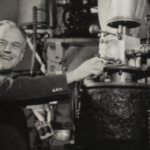
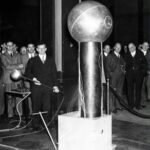
January 16, 1967 - Death of Robert Van de Graaff, whose electrostatic generator made many curious about science

Robert Jemison Van de Graaff obtained his bachelor's and master's degrees in Physics from the University of Alabama, studied for a few years at the Sorbonne University (Paris, France), and received his Ph.D. in Philosophy, in 1928, from the University of Oxford (England).
Upon his return to the United States, he first worked at Princeton University and then, in 1931, joined the staff of the prestigious Massachusetts Institute of Technology (MIT) as a research fellow. In 1934, he became an associate professor until he retired in 1960.
His research focused on nuclear physics and he invented electrostatic generators (which bear his name) that produced high voltages for the study of atomic particles. His first design, in 1929, produced 80,000 volts, but with successive modifications, in 1933, he achieved a larger generator that generated 7 million volts.
During World War II, he was director of the High Voltage Radiographic Project and, after it ended, he co-founded the High Voltage Engineering Corporation (HVEC) with John G. Trump (known for the development of radiotherapy).
In the 1950s, he invented the insulating core transformer, which produced high-voltage direct current, and tandem generator technology.
 In 1965, he was awarded the T. Bonner Prize by the American Physical Society for the development of electrostatic accelerators.
If you want to know more about this scientist and his great inventions, click on the following link: Robert Van de Graaff