August 20, 1977 – The Voyager 2 spacecraft is launched into space
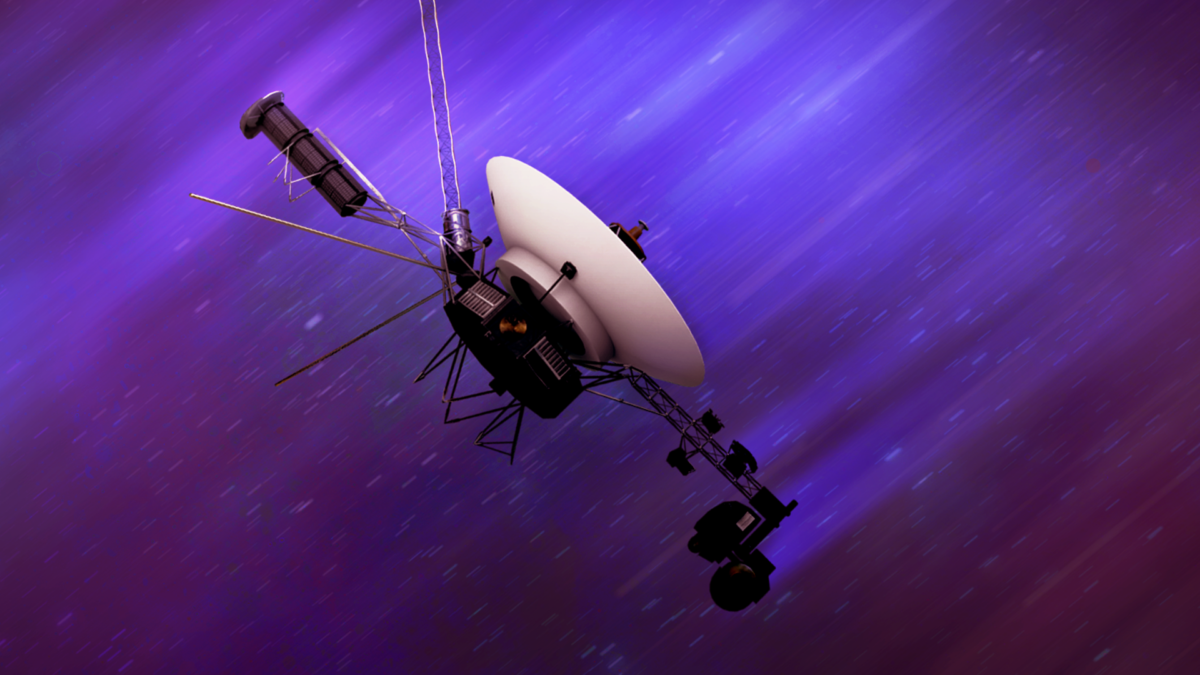
In 1977, the Voyager 2 space probe and its twin, Voyager 1, set off on a long journey from Cape Canaveral (United States) towards the distant outer planets.
Equipped with more advanced instruments than previous probes, the Voyager probes provided astronomers with spectacular images of the four planets they visited, as well as their satellites, moons, rings, etc. In the case of Voyager 2, the aim was to make use of the positions of Jupiter and Saturn, as well as the recently developed technique of gravitational assist. In this way, a single mission could visit several planets, with the cost savings that this entailed.
Interestingly, when Voyager 2 was launched, ground staff were so focused on resolving a problem that had arisen during the launch of Voyager 1 that they forgot to send Voyager 2 the activation code for its high-gain antenna. Fortunately, the team was able to contact the probe via the low-gain antenna and activate it.
On 9 July 1979, Voyager 2 came within 570,000 km of the clouds in the upper layers of the planet’s atmosphere. Although astronomers had been studying Jupiter through telescopes on Earth for centuries, scientists were surprised by the discoveries made by the probe.
On 25 August 1981, the probe approached Saturn, investigating the upper layers of the planet’s atmosphere. After flying past Saturn, Voyager 2’s camera platform malfunctioned, jeopardising plans to continue the mission to Uranus and Neptune, but the problem was resolved by making a few minor adjustments to the probe’s operations.
Voyager 2 came within 81,500 km of the uppermost layers of Uranus’s atmosphere on 24 January 1986, discovering ten moons with all their distinctive features and establishing that Uranus is a giant planet smaller than Jupiter and Saturn. Its atmosphere consists of methane and ammonia, and researchers suspect that there may be oceans of water and ice beneath its surface.
Just eight years after the probe’s flyby of Saturn, on 25 August 1989, it flew past Neptune at a distance of 4,950 km, also providing scientists with a wealth of data for their research. As it was the last of the giant planets the probe would visit, it was decided to fly past the moon Triton at a distance of 39,800 km, in a similar manner to how Voyager 1 flew past Titan.
On 10 December 2007, it was revealed that the solar system is not spherical but oval in shape, due to the interstellar magnetic field of deep space.
On 5 November 2018, it exited the heliopause, an event recorded by the Plasma Instrument, which measured a sharp drop in solar wind particles.
Between 2011 and 2019, commands were sent to adjust the probe’s operation in order to reduce its battery consumption and thus extend its operational life by at least another decade.
Located at a distance of 1,814 × 10¹⁰ km, on 21 December 2020 it became one of the most distant objects ever created by humankind.
Currently, the only antenna available for sending commands to the Voyager 2 probe is DSS 43, the Australian antenna belonging to the Deep Space Network.
From March 2020 until early 2021, communications with the probe were suspended whilst a series of upgrades were carried out on the antenna.
Although many of its instruments are no longer operational, it continues to survey the surroundings of the Solar System. It will take around 40,000 years to reach the star Ross 248, which it will pass at a distance of 1.7 light-years.
Both Voyager 1 and Voyager 2 carry a gold disc called ‘Sounds of the Earth’, 30 cm in diameter, which contains:

- 115 images explaining, in scientific terms, the location of the solar system, the units of measurement used, the characteristics of the Earth, and the characteristics of the human body and society.
- 90 minutes of a selection of music from various cultures around the world
- Greetings in 55 languages
- A message from the then Secretary-General of the United Nations.
- The piece ‘Sounds of the Earth ’ is a medley of sounds characteristic of the planet.